
Your Ads Are Getting Clicks but No Sales? 9 Marketing Funnel Leaks to Fix in 2027
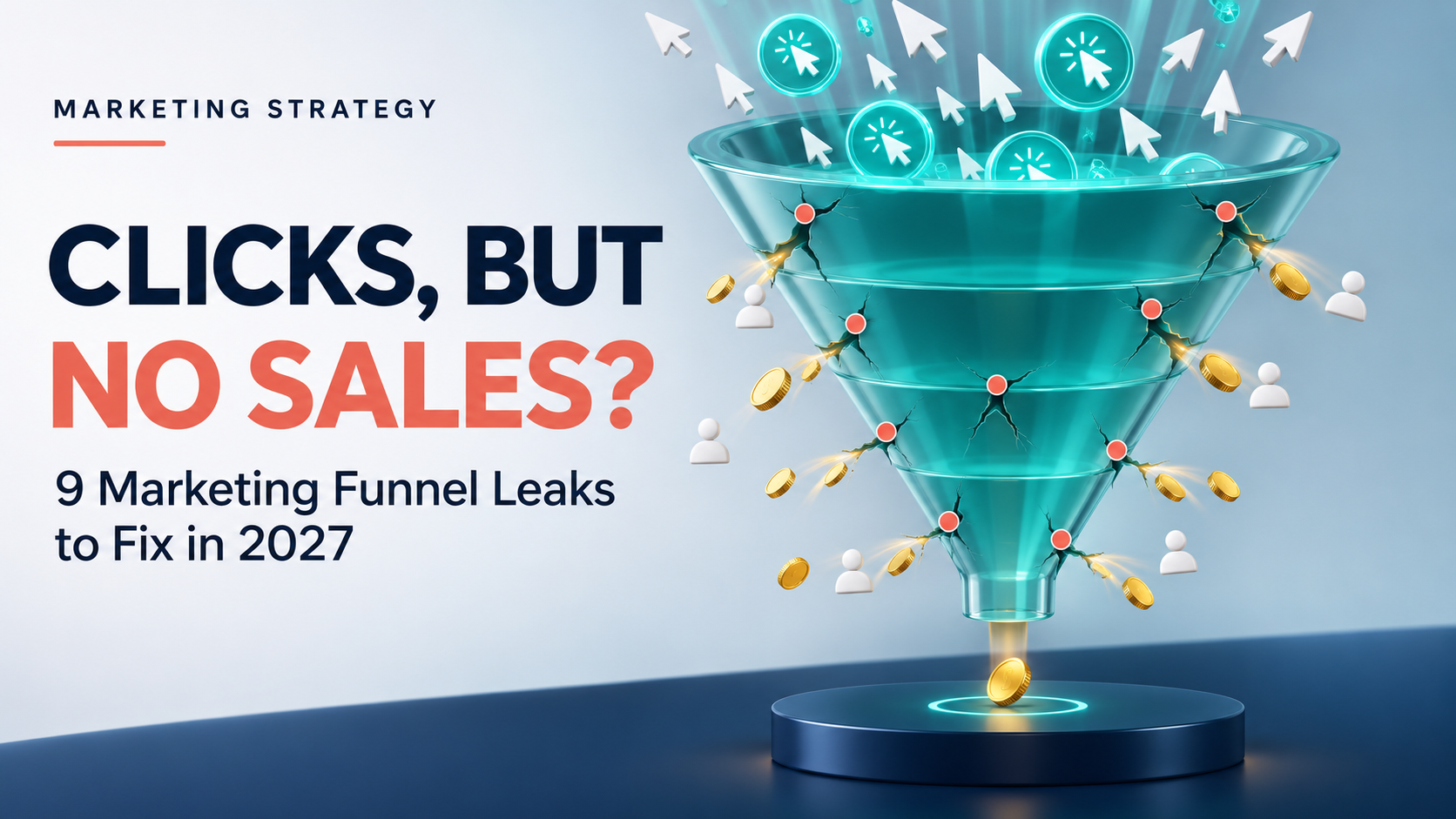
Your Google Ads are generating clicks. Your Facebook and Instagram campaigns are reaching thousands of people. Your website traffic is increasing.
Yet your enquiries remain inconsistent, and sales are not growing as expected.
Sound familiar?
The natural reaction is to blame the advertisements. Perhaps the targeting is wrong, the creatives aren’t attractive enough, or the advertising budget is too small.
But what if your advertisements aren’t the real problem?
Your marketing funnel may have gaps that cause potential customers to leave before making a purchase or enquiry.
Before spending more money on advertising in 2027, here’s what every business owner should examine.
Quick Summary: Why Are Your Ads Getting Clicks but No Sales?
Advertising campaigns can generate traffic without conversions when the customer journey contains problems such as:
- Targeting people unlikely to purchase
- Promoting offers that don’t address customer needs
- Inconsistent messaging between ads and landing pages
- Weak website copywriting
- Complicated enquiry or checkout processes
- Poor lead nurturing and delayed follow-ups
The solution isn’t always increasing your advertising budget. Sometimes, it’s identifying and fixing what happens after someone clicks.
1. Your Advertisements Are Attracting the Wrong Audience
High reach and low-cost clicks can look impressive in an advertising report.
But are those visitors potential customers?
Imagine a US-based business advertising premium products. Its campaigns generate thousands of clicks, but most visitors come from countries where the business doesn’t deliver.
The traffic looks promising. The commercial opportunity is limited.
What to check: Audience location, search intent, demographics where relevant, search terms, lead quality, and actual purchasing behaviour.
The goal is not simply to attract more visitors. It’s to attract people who are likely to need your products or services.
2. Your Offer Doesn't Give Customers a Reason to Act
An advertisement can be beautifully designed and still fail because the offer isn’t compelling.
Consider two messages:
“We provide professional marketing services.”
“Your ads are getting clicks but no enquiries? Discover where your marketing funnel is losing customers.”
The second message addresses a specific problem and gives the audience a reason to explore further.
A strong offer connects the customer’s current challenge with a relevant solution.
What to check: Does your offer solve a genuine problem, communicate clear value, and explain why someone should take the next step?
3. Your Ad and Landing Page Make Different Promises
This is one of the most overlooked advertising conversion problems.
Suppose someone clicks an advertisement offering a complimentary marketing audit.
Instead of reaching a page explaining the audit, they land on a generic homepage describing multiple services.
The visitor now has to search for the offer that attracted them.
Many won’t bother.
What to check: Your advertisement, landing-page headline, offer details, and call to action should communicate one consistent promise.
This is known as message match, and it helps visitors understand that they’ve reached the right place.
4. Your Website Talks About Your Business, Not the Customer's Problem
Businesses often fill their websites with statements such as:
“We are a leading company.”
“We provide innovative solutions.”
“We offer high-quality services.”
These statements may describe the business, but they don’t necessarily explain why customers should care.
Effective website copywriting connects a customer’s problem with a relevant solution.
For example, instead of saying “We provide marketing automation services,” explain how automation can reduce repetitive work, improve follow-ups, and prevent potential leads from being overlooked.
What to check: Can visitors understand what problem you solve within the first few seconds of reaching your page?
5. Your Website Makes Enquiring or Purchasing Difficult
A potential customer may be interested in your offer but abandon the process because the website creates unnecessary friction.
Common problems include:
- Slow-loading pages
- Poor mobile experiences
- Broken buttons or links
- Complicated enquiry forms
- Unexpected checkout costs
- Confusing navigation
- Unclear next steps
Even small obstacles can affect conversion opportunities.
What to check: Test your customer journey on mobile and desktop, from clicking the advertisement to completing the intended action.
6. You're Asking Customers to Buy Before Building Trust
Not everyone who clicks an advertisement is ready to purchase.
Some visitors are comparing options. Others need reassurance, more information, or evidence that your business can deliver.
This is especially important for B2B services, consulting, high-value purchases, and products with longer buying cycles.
Trust-building content may include case studies, relevant testimonials, practical guides, FAQs, and clear explanations of your process.
What to check: Does your marketing provide enough information to help hesitant customers make informed decisions?
7. Your Lead Follow-Up System Is Weak
Generating a lead is only one stage of the customer journey.
What happens after someone submits an enquiry?
If nobody responds promptly, or the prospect receives an immediate sales pitch without useful information, interest may fade.
Email nurturing, CRM workflows, reminders, and personalised follow-ups can help maintain communication.
What to check: How quickly are leads contacted, who is responsible for follow-up, and what happens when a prospect isn’t ready to buy?
Automation can support the process, but important customer conversations still benefit from human understanding.
8. You're Measuring Clicks Instead of Business Results
Advertising platforms provide valuable data, including impressions, reach, clicks, and conversions.
But those numbers don’t always reveal whether campaigns are generating profitable customers.
A campaign may report a low cost per lead while producing enquiries that never become sales.
Another may generate fewer leads but attract customers with greater purchasing intent.
What to check: Connect advertising reports with lead quality, sales outcomes, acquisition costs, and revenue wherever reliable tracking is available.
The objective is to understand what the business gains from its advertising investment.
9. Your Marketing Channels Aren't Working Together
Your business may have a website, social media accounts, paid advertising campaigns, email lists, and CRM software.
But are they connected?
For example:
- Social media content attracts attention.
- An advertisement introduces an offer.
- A landing page explains the solution.
- A lead magnet encourages an enquiry.
- Email nurturing builds trust.
- A consultation or purchase completes the journey.
When these activities operate independently, customers can fall through the gaps.
What to check: Map the complete customer journey and identify where messaging, technology, or follow-up processes become disconnected.
The 2027 Marketing Funnel Audit Checklist
Before increasing your advertising budget, review these questions:
Area | Question to ask |
Audience | Are we attracting potential customers in our target market? |
Offer | Does our offer solve a relevant customer problem? |
Advertising | Does the message reflect buyer motivations and expectations? |
Landing page | Does the page deliver what the advertisement promises? |
Website | Is the next action clear and easy to complete? |
Trust | Do we provide enough information to support buying decisions? |
Follow-up | Are enquiries contacted and nurtured consistently? |
Tracking | Can we connect campaign performance with business outcomes? |
Customer journey | Do our marketing channels work together? |
You don’t necessarily need to rebuild your entire marketing system.
Sometimes, identifying one significant bottleneck can reveal where improvements should begin.
Frequently Asked Questions
Why are my Facebook Ads getting clicks but no sales?
Possible reasons include poor audience targeting, weak offers, landing-page mismatches, website problems, or ineffective follow-ups. Review the complete customer journey before changing campaign settings.
What is a good conversion rate for paid advertising?
There is no universal conversion rate that applies to every business. Performance depends on your industry, offer, audience, advertising platform, and what you count as a conversion.
Should I increase my advertising budget if sales are low?
Not automatically. First examine campaign targeting, lead quality, conversion tracking, landing-page performance, and customer follow-up. Increasing spend can amplify existing problems.
What is a marketing funnel audit?
A marketing funnel audit examines how customers move from initial awareness to enquiry, purchase, and retention. It identifies potential gaps in messaging, offers, website experience, tracking, and follow-up.
Can marketing automation improve advertising conversions?
Automation can help with lead capture, reminders, follow-ups, and CRM processes. However, automating a poorly designed customer journey won't necessarily improve conversions.
Conclusion: Stop Looking Only at the Advertisement
In 2027, businesses need more than effective advertisements.
They need a connected customer journey that attracts the right audience, communicates relevant offers, builds trust, and makes the next step easy.
Your advertising campaign may be working exactly as intended.
The real problem could be what happens before or after the click.
Before investing more money in advertising, identify where your marketing efforts are losing potential customers.
Is Your Marketing Budget Leaking Opportunities?
At LITOS, we don’t simply manage Google, Meta, YouTube, and other advertising campaigns.
We examine the gaps between advertising, website messaging, offers, lead nurturing, automation, and customer conversions.
Our approach combines buyer psychology, marketing strategy, persuasive copywriting, and practical execution to help businesses make more informed growth decisions.
Find the Gap. Fix the System. Grow with Purpose.
Visit www.litos.co.in to explore how LITOS can help identify opportunities for improvement in your marketing system.