
Building High-Performing Teams: Why Trust, Clarity and Mindful Leadership Matter

Quick Summary
High-performing teams are not simply groups of talented employees. They are teams that consistently produce strong results because people understand what they are working towards, trust one another, communicate openly and take responsibility for shared outcomes.
Building such a team requires clear goals, defined roles, psychological safety, accountability, constructive communication and leadership that enables people rather than constantly controlling them.
Mindfulness strengthens these conditions by helping leaders and employees listen more carefully, manage reactions, communicate with greater awareness and remain focused under pressure.
The objective is not maximum output at any cost. A genuinely high-performing team produces strong results while remaining adaptable, engaged and capable of sustaining performance over time.
High Performance Is About More Than Hiring High Performers
Put five exceptionally talented people into the same room and you do not automatically have an exceptional team.
You may simply have five talented individuals.
This distinction matters because organisations frequently attempt to improve team performance by concentrating primarily on individual capability. They recruit stronger candidates, introduce individual targets, provide technical training and reward top performers.
Individual competence is important. But teams succeed or fail through interaction.
Can people disagree without the conversation becoming personal?
Does everyone understand what the team is trying to accomplish?
Will someone raise a concern when they notice a problem?
Can employees make decisions without waiting for constant approval?
Do team members share information or protect it?
Can people admit mistakes without immediately becoming defensive?
Research into high-performing teams repeatedly points towards human factors such as leadership, psychological safety and emotional intelligence as critical contributors to performance.
McKinsey’s work on high-performing leadership teams similarly identifies three important dimensions: alignment on direction, high-quality interaction characterised by trust and open communication, and an environment that provides renewal, learning and energy.
The lesson is straightforward.
High-performing teams are built through the quality of the environment in which capable people work together.
What Is a High-Performing Team?
A high-performing team is a group of people who consistently work together to achieve shared goals while maintaining strong levels of trust, accountability, adaptability and engagement.
The word consistently is important.
A team that delivers one extraordinary project by working nights and weekends is not necessarily high-performing.
A sales team that exceeds its quarterly target while losing half its employees may have achieved a strong result, but the way that result was produced is unlikely to be sustainable.
True high performance combines results with the capacity to continue producing those results.
High-performing teams generally demonstrate:
- Clear shared objectives
- Defined responsibilities
- Open communication
- Psychological safety
- Mutual trust
- Constructive disagreement
- Individual and collective accountability
- Adaptability
- Effective decision-making
- Continuous learning
- Sustainable working practices
They also understand how their individual responsibilities contribute to the larger objective.
This reduces one of the most common sources of workplace frustration: people working hard without understanding whether their efforts are genuinely moving the organisation forward.
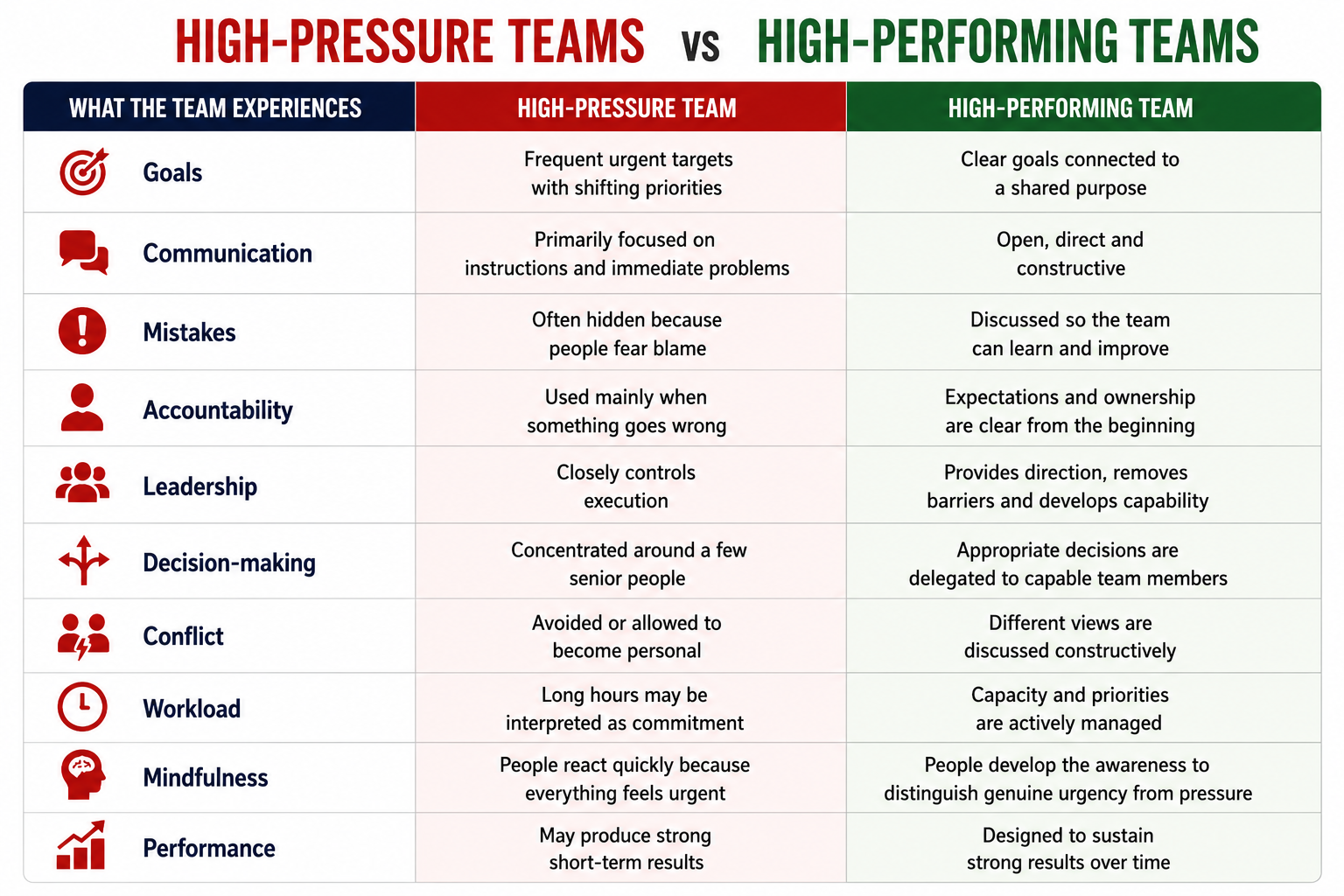
The difference becomes particularly visible during difficult periods.
Pressure reveals the team’s operating culture.
A team built primarily around fear and individual heroics may perform while conditions are predictable. When uncertainty increases, information becomes guarded, mistakes are concealed and blame begins to replace collaboration.
Strong teams behave differently.
They communicate more, not less.
1. Give the Team a Clear Shared Purpose
People cannot align around a goal they do not understand.
Yet teams often receive targets without enough context.
“Increase sales.”
“Improve customer experience.”
“Grow engagement.”
“Complete the project faster.”
These may be legitimate objectives, but they do not automatically create alignment.
A strong team needs to understand:
What are we trying to accomplish? Why does it matter? What does success look like? What role does each person play?
Purpose provides the larger context. Goals translate that purpose into measurable outcomes.

When people understand both, everyday decisions become easier.
Instead of asking the manager about every small issue, employees can ask whether a particular action supports the team’s objective.
Leaders should therefore communicate direction repeatedly, particularly during periods of change.
A goal mentioned once in an annual meeting is unlikely to guide hundreds of daily decisions.
2. Create Role Clarity Without Creating Silos
Team members need to understand what they own.

When responsibilities are vague, predictable problems appear:
Two people assume the other person is handling something.
Several employees duplicate the same work.
Important decisions remain unresolved because nobody knows who has authority.
Or one capable employee becomes the default person for everything.
Clear roles prevent this confusion.
But role clarity should not become rigidity.
High-performing teams understand individual ownership while remaining willing to help one another when circumstances require it.
Leaders can clarify:
- Who owns the outcome?
- Who makes the final decision?
- Who contributes?
- Who needs to be informed?
- Where do responsibilities overlap?
- When should an issue be escalated?
Clarity reduces friction without eliminating collaboration.
3. Build Psychological Safety
Psychological safety means people can raise ideas, questions, concerns and mistakes without fearing humiliation or punishment.
It does not mean avoiding difficult conversations.
It means making difficult conversations possible.
When psychological safety is low, employees learn to protect themselves.
They may notice that a deadline is unrealistic but remain silent.
They may identify a flaw in a strategy but assume leadership does not want to hear it.
They may make an error and spend more energy hiding it than correcting it.
Silence can make a team appear harmonious while significant problems develop beneath the surface.
Psychological safety is therefore not simply an employee wellbeing concept. It affects decision quality, innovation and risk management.

Leaders shape it through everyday reactions.
When someone disagrees with you, what happens?
When an employee admits a mistake, is your first response curiosity or accusation?
When someone asks for help, do you interpret it as responsibility or incompetence?
People remember these moments.
They learn from them whether speaking openly is genuinely safe.
4. Combine Psychological Safety with Accountability
Safety without accountability can become comfort.
Accountability without safety can become fear.

High-performing teams need both.
People should feel safe saying:
“I made a mistake.”
But the next question must be:
“What are we going to do about it?”
Similarly, employees should be able to challenge a decision while remaining responsible for executing the final agreed direction.
Accountability works best when expectations are established before performance is measured.
Every team member should know:
- What outcome they own
- What standard is expected
- When it is required
- Which resources are available
- When they should ask for help
- How progress will be evaluated
This shifts accountability away from blame and towards ownership.
5. Make Trust a Daily Practice
Teams do not build trust during one annual team-building activity.
Trust develops through hundreds of small interactions.
People notice whether colleagues:
Keep commitments.
Share relevant information.
Give credit.
Admit mistakes.
Respect confidential conversations.
Support each other under pressure.
Speak directly rather than creating unnecessary politics.
Trust becomes particularly important when employees depend on one another to complete interconnected work.
A missed commitment does not affect only one person. It can delay an entire chain of responsibilities.
Leaders can strengthen trust by making reliability visible.
If a commitment cannot be met, communicate early.

If circumstances change, explain why.
If someone else contributed to a success, acknowledge them.
Trust is rarely built through dramatic gestures. It is built through consistency.
6. Communicate to Understand, Not Merely to Respond
Teams can spend hours communicating while understanding very little.
Emails, meetings, instant messages and project tools have increased the volume of workplace communication. They have not necessarily improved its quality.

High-performing teams communicate with intention.
They know when something requires:
- A quick message
- A documented instruction
- A meeting
- A private conversation
- A group discussion
- No communication at all
Mindfulness at the workplace becomes especially useful here.
Mindful communication means giving enough attention to understand what another person is actually saying before preparing a response.
Consider how frequently workplace disagreements escalate because someone interrupts, assumes intent or responds to one sentence without understanding the wider concern.
A brief pause changes the quality of the conversation.
It allows someone to ask:
What am I hearing? What am I assuming? What needs clarification before I respond?
This does not make communication slower.
It often prevents the much greater time lost repairing misunderstandings later.
7. Encourage Constructive Conflict
A team in which everyone agrees all the time should concern a leader.
Either the organisation has achieved extraordinary intellectual alignment, or people have stopped expressing what they actually think.
High-performing teams disagree.
They challenge assumptions, question plans and offer alternative ideas.
The difference is that disagreement remains focused on the issue rather than becoming an attack on the person.
Leaders can encourage constructive conflict by asking:
“What are we missing?”
“Who sees this differently?”
“What could make this plan fail?”
“What assumption should we challenge?”
“What would someone outside this team question?”
Mindful leadership is valuable during disagreement because leaders become more conscious of defensiveness.

Being challenged can trigger an immediate desire to justify a decision.
Noticing that reaction before responding creates space for curiosity.
Sometimes the person challenging you is wrong.
Sometimes they have noticed exactly what everyone else missed.
8. Give People Ownership, Not Just Tasks
Micromanagement can produce compliance.
It rarely produces high performance.
Employees develop capability when they are trusted with meaningful outcomes and appropriate decision-making authority.

Instead of saying:
“Do these seven steps exactly as I have written them.”
A leader might establish:
“This is the outcome we need. These are the boundaries. These are the resources available. Come to me if these conditions change.”
The second approach requires more trust.
It also encourages judgement, responsibility and initiative.
Delegation should therefore include:
- A clear outcome
- Decision boundaries
- Required standards
- Available resources
- Relevant deadlines
- Check-in points
- Freedom over appropriate methods
Leaders who delegate only tasks remain the thinking centre of the team.
Leaders who delegate responsibility develop other thinkers.
9. Build Feedback into Normal Work
Feedback should not arrive as an annual surprise.
High-performing teams use feedback continuously to improve how work is done.
This includes positive feedback.
When something works well, ask why.
What did the team do differently?
Which behaviour should be repeated?
What enabled the success?
Similarly, when something fails, the conversation should move beyond identifying who was responsible.
Ask:
What happened?
What information did we have at the time?
Which assumption proved incorrect?
Was the process unclear?
What should we change before repeating this work?

This creates a learning culture rather than a blame culture.
Mindfulness helps both the giver and receiver of feedback separate the information from the emotional reaction it may initially create.
10. Protect Energy as Seriously as Productivity
High performance requires energy.
Yet some organisations behave as though employee capacity is unlimited.

A team may sustain an intense workload for a launch, crisis or important deadline.
The problem begins when exceptional effort becomes the normal operating model.
Constant urgency reduces concentration, creativity and patience. Eventually, employees may begin delivering work while becoming increasingly disengaged or exhausted.
Leaders should monitor:
- Persistent overtime
- Unrealistic deadlines
- Repeated weekend work
- Meeting overload
- Constant digital interruptions
- Uneven workload distribution
- Unused annual leave
- Dependence on a few “reliable” employees
Mindfulness does not solve excessive workload. Workplace mental wellness also requires attention to workload, recovery and sustainable working practices.
It does help individuals and leaders recognise signs of overload earlier, rather than normalising them until burnout appears.
Sustainable performance requires recovery.
11. Develop Emotional Intelligence Across the Team
Teams are human systems.
People bring ambition, frustration, confidence, insecurity, enthusiasm and stress into the workplace.
Pretending these emotions do not exist does not remove their influence.
Emotional intelligence helps team members recognise their own reactions and respond appropriately to others.
It improves:
- Difficult conversations
- Feedback
- Conflict resolution
- Leadership
- employee engagement strategies
- Customer interactions
- Change management
A technically excellent employee who repeatedly damages relationships may reduce overall team performance.

Conversely, emotional intelligence without competence is not enough.
High-performing teams require both professional capability and the interpersonal skills to use that capability collaboratively.
12. Make Reflection Part of Performance
Teams are often encouraged to move quickly from one project to the next.

Complete.
Submit.
Move on.
This leaves valuable learning behind.
High-performing teams create space to reflect.
After an important project, ask:
What worked?
What did not?
What surprised us?
What should we repeat?
What should we stop doing?
What will we change next time?
This is one of the simplest ways mindfulness can become part of team culture without turning every workplace initiative into a meditation programme.
Mindfulness begins with attention.
A team that consciously notices how it works can improve how it works.
A team that never reflects is likely to repeat avoidable problems.
The Role of the Leader in Building High-Performing Teams
Leaders cannot demand high performance into existence.
They create the conditions that make it possible.
That means moving beyond supervision towards enablement.
An effective team leader:
People know what matters and why.
Roles, expectations and decision-making responsibilities are understood.
Employees can raise concerns, admit errors and challenge assumptions respectfully.
Psychological safety does not eliminate performance expectations.
Leaders identify unnecessary processes, resource constraints and organisational barriers that prevent good work.
Team members receive feedback, opportunities and responsibility that increase their capability.
Leaders cannot demand openness while reacting defensively to criticism.
They cannot promote work-life balance while sending routine messages at midnight.
They cannot request accountability while refusing to acknowledge their own mistakes.
The leader’s behaviour teaches the team what the organisation genuinely values.
A Mindful Framework for Improving Team Performance
Organisations do not need to redesign everything simultaneously.
Begin with five questions.
Can every team member explain the team’s priorities and their role in achieving them?
Can employees raise concerns, disagree and admit mistakes without unnecessary fear?
Are We Accountable?
Does everyone understand what they own and what standard is expected?
Do meetings and conversations create understanding, or are people primarily waiting for their opportunity to speak?
Can the team maintain its current level of performance without chronic exhaustion?
These questions provide a useful starting point for leadership discussions, corporate training programmes, team workshops and organisational assessments.
Common Objections to Building High-Performing Teams
Talent is an advantage, not a guarantee.
Highly capable individuals can still underperform collectively when priorities conflict, communication is weak or trust is absent.
Psychological safety does not mean lowering standards.
Strong teams combine openness with clear accountability. People can question ideas while remaining responsible for results.
Poor teamwork already consumes time through duplicated work, misunderstandings, avoidable meetings, repeated mistakes and unresolved conflict.
Team development should improve work, not sit beside it as an unrelated activity.
Mindfulness is the ability to pay attention with greater awareness.
In teams, that can mean listening before reacting, recognising emotional triggers, focusing during important work and noticing problems before they escalate.
Those are performance capabilities.
Remote and hybrid work change how trust is built, but they do not make it impossible.
Remote teams need greater intentionality around communication, expectations, documentation, informal connection and availability.
Frequently Asked Questions
What is a high-performing team?
A high-performing team consistently achieves strong shared outcomes through clear goals, trust, accountability, effective communication, adaptability and collaboration.
What are the characteristics of high-performing teams?
Common characteristics include clear purpose, role clarity, psychological safety, mutual trust, accountability, constructive conflict, strong communication, adaptability and continuous learning.
How do you build a high-performing team?
Begin by establishing clear goals and responsibilities. Develop psychological safety and accountability, improve communication, delegate meaningful ownership and create regular feedback and reflection.
Why is psychological safety important for team performance?
Psychological safety allows employees to raise concerns, ask questions, share ideas and acknowledge mistakes. This helps teams identify problems earlier and learn more effectively.
Does psychological safety mean lowering performance standards?
No. Psychological safety and accountability should exist together. Employees should feel safe speaking honestly while remaining responsible for delivering agreed outcomes.
What role does leadership play in high-performing teams?
Leaders establish direction, create clarity, model behaviour, develop people, remove barriers and influence whether employees feel safe speaking openly.
How does mindfulness improve team performance?
Mindfulness can improve attention, listening, emotional awareness and the ability to pause before reacting. These capabilities support communication, decision-making and constructive conflict.
Can remote teams become high-performing teams?
Yes. Remote teams can perform strongly when goals, roles, communication expectations and decision-making processes are clear and leaders intentionally create opportunities for trust and connection.
How can organisations measure team performance?
Measures may include business outcomes, quality, productivity, customer results, employee engagement, retention, goal achievement, collaboration and feedback from team members.
How long does it take to build a high-performing team?
There is no fixed timeline. Trust, accountability and effective working relationships develop through consistent behaviour. Leadership changes can improve conditions quickly, but sustainable team culture develops over time.
Conclusion: High Performance Begins with the Environment People Work In
Building high-performing teams is not about finding employees who can tolerate more pressure.
It is about creating conditions in which capable people can consistently do their best work together.
Clear purpose gives people direction. Role clarity reduces friction. Psychological safety allows problems and ideas to surface. Accountability protects standards. Trust enables collaboration. Mindfulness improves the quality of attention, communication and response.
When these conditions exist together, performance becomes less dependent on constant supervision and individual heroics.
The strongest teams do not merely work harder.
They understand what matters, trust one another enough to communicate honestly and take shared responsibility for achieving the result.
To strengthen these capabilities within your organisation, explore Litos’ Corporate Training programmes, Business Consulting services, Leadership Development programmes, Employee Engagement resources and Mindfulness at the Workplace. You can also contact the Litos team to discuss a customised programme for building stronger, more collaborative and sustainable high-performing teams.