
Burnout Recovery at Work: A Mindful Path Back to Energy, Clarity and Effectiveness
Quick Summary
Burnout is not simply a difficult week or temporary tiredness. The World Health Organization describes it as an occupational phenomenon resulting from chronic workplace stress that has not been successfully managed. It is characterised by exhaustion, growing mental distance or cynicism towards work, and reduced professional effectiveness.
Burnout recovery requires more than taking a weekend off. Employees may need rest, psychological detachment from work, clearer boundaries, supportive conversations and healthier daily routines. Organisations must also examine workloads, staffing, role clarity and business consulting services that improve workplace systems.
Mindfulness can support recovery by helping people recognise stress signals, regulate reactions and become more present. However, mindfulness should complement—not replace—meaningful organisational changes.
Burnout Is a Workplace Signal, Not a Personal Failure
Burnout often develops quietly.
An employee may initially feel unusually tired. They begin postponing tasks that once felt manageable. Meetings become irritating. Small mistakes feel overwhelming. They may continue performing, but the effort required becomes much greater.
Because these changes happen gradually, people often blame themselves.
They assume they need to become more disciplined, positive or productive. They respond by working longer, checking messages later at night or sacrificing breaks to catch up. These efforts may temporarily conceal the problem while increasing the exhaustion beneath it.
The World Health Organization classifies burnout as an occupational phenomenon rather than a medical condition. Its definition specifically connects burnout with chronic workplace stress that has not been managed successfully.
This distinction matters.
Burnout is not evidence that an employee is weak. It can indicate that the demands of work have remained higher than the resources, support or control available to manage them.
The CDC similarly explains that job stress occurs when work requirements do not match a worker’s capabilities, resources or needs. It advises that changes in workplace policies and practices are among the most effective ways to address employee mental health and workplace mental wellness.
Recovery, therefore, cannot be treated only as the employee’s responsibility.
What Burnout Can Look Like at Work
Burnout does not appear identically in every employee.
Some people become visibly emotional or disengaged. Others remain highly productive while becoming increasingly exhausted, detached and dependent on constant effort.
Common signs may include:
- Persistent physical or mental exhaustion
- Difficulty concentrating
- Reduced motivation
- Irritability or impatience
- Cynicism about work, colleagues or leadership
- Feeling ineffective despite working hard
- Avoiding tasks or conversations
- More mistakes than usual
- Difficulty switching off after work
- Loss of satisfaction in accomplishments
- Anxiety about returning to work
- Withdrawal from colleagues
- Sleep disruption
- Working longer to achieve the same result
The CDC notes that work-related stress may involve tiredness, feeling overwhelmed, irritability, anxiety, helplessness, reduced motivation, sleep difficulties and problems concentrating. It also warns that burnout can affect employee engagement and retention.
These signs can also overlap with physical or mental health conditions. Employees experiencing severe, persistent or worsening symptoms should seek coaching and counselling and counselling support from an appropriately qualified healthcare or mental-health professional rather than relying entirely on workplace wellness advice.
Why Rest Alone May Not Resolve Burnout
Rest matters, but recovery from burnout is rarely achieved through one holiday, one quiet weekend or one wellness activity.
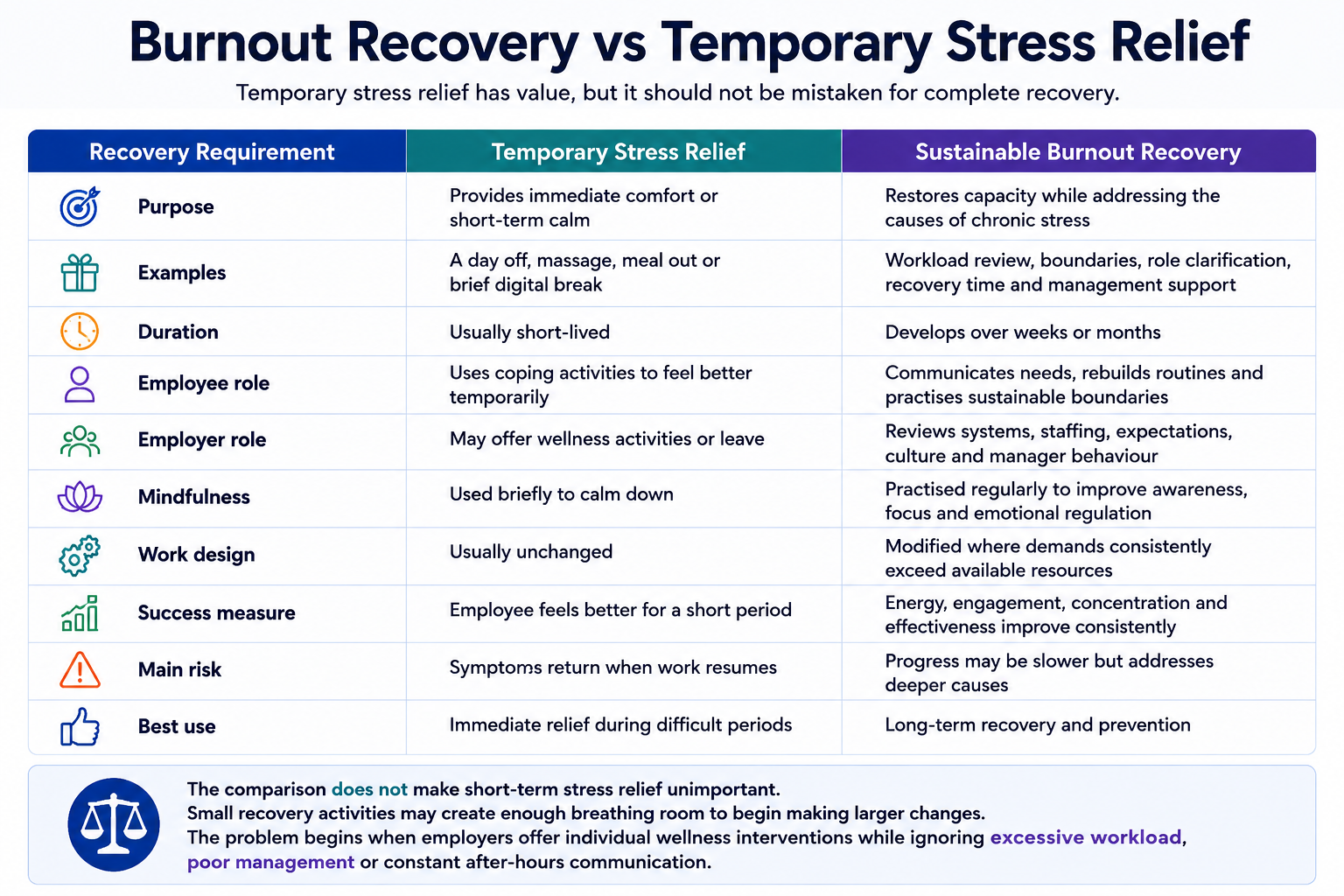
An employee may feel better after time away and become exhausted again shortly after returning. This usually means the underlying causes remain unchanged.
Common workplace contributors include:
- Excessive or unpredictable workloads
- Insufficient staffing
- Lack of control over how work is completed
- Conflicting priorities
- Unclear roles
- Constant digital availability
- Inadequate support from managers
- Poor recognition
- Repeated organisational change
- Workplace conflict
- Values that conflict with actual practices
- Limited opportunities for development
- Unfairness or inconsistent treatment
Recovery requires both relief and correction.
Relief helps the person regain physical and emotional capacity. Correction reduces the likelihood that the same working conditions will recreate the problem.
Research on recovery from job stress highlights the importance of psychological detachment: periods in which people are neither performing job-related activities nor continuing to think about work. Difficulty detaching is associated with greater strain, poorer wellbeing and burnout.
Taking time off while continuing to monitor email every hour is not genuine detachment.
Step 1: Recognise Burnout Without Judging Yourself
Recovery begins with an honest acknowledgement that the current pattern is not sustainable.
People experiencing burnout may resist this step because they associate exhaustion with incompetence. Senior leaders, founders and high performers may feel particularly uncomfortable admitting that they are struggling.
A more constructive question is:
What has my mind and body been trying to communicate?
Keep a short record for one or two weeks. Note:
- When energy drops most sharply
- Which tasks create the strongest resistance
- Whether irritation is linked to particular situations
- When work continues mentally after the working day
- Which responsibilities feel unclear or uncontrollable
- Whether rest produces meaningful improvement

This is not intended to create another performance-tracking exercise. It helps identify patterns that may otherwise remain hidden.
Mindfulness supports this stage by encouraging observation without immediate judgement. Instead of labelling yourself lazy or incapable, notice the experience accurately: fatigue is present, concentration is reduced, or resentment is building.
Accurate awareness makes useful action more likely.
Step 2: Create Genuine Psychological Detachment
Recovery requires periods during which the nervous system is not continually anticipating work.

Recovery requires periods during which the nervous system is not continually anticipating work.
This may involve:
- Defining a clear end to the working day
- Turning off non-essential notifications
- Keeping the phone away during meals
- Avoiding work conversations during designated rest periods
- Using annual leave without monitoring routine messages
- Creating a transition ritual between work and home
- Spending time on activities that require different forms of attention
The APA recommends regular periods of switching off from work. It also identifies meditation, breathing exercises and mindfulness as potentially helpful methods for managing workplace stress and strengthening purposeful attention.
A simple mindful transition can take five minutes.
Before leaving work or shutting down the computer, pause and identify:
- What was completed today?
- What can wait until tomorrow?
- What am I carrying mentally that does not need action tonight?
- What deserves my attention outside work now?
This small ritual helps the mind recognise that the working day has ended.
Step 3: Discuss the Work, Not Only the Symptoms
Employees often tell managers that they feel stressed without explaining which working conditions are creating the stress.
A more productive conversation identifies specific factors.
Instead of saying:
“I cannot manage anymore.”
It may help to explain:
“Three projects currently have the same deadline, and each has been described as the highest priority. I need clarity on which outcome should come first.”
Other useful discussion points include:
- Workload and deadlines
- Conflicting expectations
- Resources or staffing
- Decision-making authority
- After-hours communication
- Repeated interruptions
- Unclear responsibilities
- Support during organisational change
- Possibility of temporary workload adjustment
- Access to professional support

The CDC encourages workers to communicate about job stress, identify the factors causing it and work collaboratively on solutions. It also emphasises the significant role managers can play in preventing and reducing workplace stress.
A supportive manager should listen without treating the disclosure as a lack of commitment.
Step 4: Rebuild Capacity Gradually
A burned-out employee may return from leave expecting to perform at full intensity immediately.
This can recreate the same cycle.

Recovery is more sustainable when capacity is rebuilt gradually through:
- Realistic daily priorities
- Protected focus time
- Reduced task switching
- Regular breaks
- Consistent sleeping and eating routines
- Physical movement
- Reduced non-essential commitments
- Manageable performance expectations
- Supportive check-ins
- Clear escalation pathways
The objective is not to avoid responsibility permanently. It is to restore the ability to handle responsibility without relying on constant overextension.
Mindfulness can be integrated into the working day through brief practices:
- Three conscious breaths before opening email
- One minute of silence before an important meeting
- Eating one meal without a screen
- Listening fully before responding
- Noticing physical tension during transitions
- Walking briefly without checking the phone
Workplace mindfulness research has found that sustained training may support attention, job satisfaction and a healthier relationship with work, although mindfulness should not be presented as a complete organisational solution.
Step 5: Re-establish Boundaries That Can Survive Busy Periods
A boundary is useful only when it can be maintained.
Vague commitments such as “I will work less” are difficult to apply. Effective boundaries are more specific:
- No routine email after a defined time
- Meetings kept within agreed working hours
- One uninterrupted lunch break
- No acceptance of additional tasks without reviewing existing priorities
- Defined emergency communication channels
- Protected weekly time for focused work
- Clear ownership of responsibilities
- Scheduled leave taken rather than accumulated indefinitely
Boundaries may initially feel uncomfortable, particularly in cultures where availability is treated as loyalty.
However, constant access is not the same as effective contribution.

Leaders also need boundaries. A manager who sends messages late at night may unintentionally communicate that immediate responses are expected, even when the message says otherwise.
Step 6: Reconnect Work with Meaning and Control
Burnout is not caused only by workload.
People can work intensely and remain engaged when they have purpose, autonomy, support and a sense that their efforts matter. Conversely, moderate workloads can become draining when work feels pointless, unfair or uncontrollable.

when work feels pointless, unfair or uncontrollable.
Recovery conversations should therefore include:
- Which parts of the role still feel meaningful?
- Which responsibilities use the employee’s strengths?
- What decisions could they own more fully?
- What work should be reduced, redesigned or stopped?
- What skills would make the role more manageable?
- What recognition or feedback is missing?
- Has the role changed without being formally redefined?
Not every job can be redesigned completely. Even modest improvements in clarity, autonomy and feedback may help employees regain a sense of effectiveness.
What Managers Must Do to Support Burnout Recovery
Managers should not diagnose employees. They should create working conditions in which employees can raise concerns and access appropriate support.
Useful management actions include:
Do not respond to burnout by offering productivity advice before examining whether the volume of work is realistic.
When everything is urgent, employees are left to absorb the conflict personally.
Avoid unnecessary contact during evenings, weekends and leave.
Allow employees reasonable influence over methods, scheduling and task sequencing.
When several employees show similar signs, the problem is unlikely to be individual resilience.
Ensure employees know how to access counselling, employee assistance or occupational-health resources where available.
Leaders who never disconnect make recovery feel professionally unsafe for everyone else.
Organisational interventions are essential because burnout can develop when demands remain high while workers lack sufficient resources to meet them.
Common Objections to Burnout Recovery at Work
Continuing to work while severely depleted may increase mistakes, delays and poor decisions. Time away should be combined with a realistic return-to-work plan rather than followed by an unchanged backlog.
That is correct.
Mindfulness may help an individual notice stress, regulate reactions and communicate more clearly. It cannot compensate for chronic understaffing, unreasonable expectations, bullying or unsafe working conditions.
Different employees may require different support to achieve sustainable performance. Fairness does not always mean treating every person identically.
Not necessarily. Burnout may reflect prolonged mismatch between demands and available resources rather than a lack of ability.
A holiday may provide valuable rest. If the causes of burnout remain unchanged, symptoms may return shortly after work resumes.
Frequently Asked Questions
What is burnout?
Burnout is an occupational phenomenon associated with chronic workplace stress that has not been managed successfully. It involves exhaustion, greater mental distance or cynicism towards work, and reduced professional efficacy.
How is burnout different from ordinary stress?
Stress may involve feeling pressured or overloaded while still remaining engaged. Burnout commonly includes deeper exhaustion, detachment and a reduced sense of effectiveness.
How long does burnout recovery take?
There is no universal timeline. Recovery depends on the severity and duration of the problem, workplace conditions, available support and whether underlying causes are changed.
Can mindfulness help with burnout?
Mindfulness may support attention, emotional regulation and awareness of stress signals. It is most useful when combined with rest, boundaries, support and organisational improvements.
Should I resign if I am burned out?
Resignation is a personal decision and not the only possible response. Consider whether workload, role design, management support or boundaries can be improved. Professional guidance may also help when the decision feels overwhelming.
Can managers prevent employee burnout?
Managers cannot control every contributing factor, but they can reduce unnecessary workload conflict, clarify expectations, protect recovery time, provide support and escalate systemic issues.
Is burnout a medical condition?
The WHO classifies burnout as an occupational phenomenon, not a medical condition. However, its symptoms may overlap with other conditions, so persistent or severe symptoms should be discussed with a qualified healthcare professional.
Can high-performing employees experience burnout?
Yes. High performers may continue delivering results while becoming increasingly exhausted, detached or dependent on unsustainable effort.
What should employers measure?
Employers can monitor workload, overtime, absenteeism, turnover, employee feedback, role clarity, psychological safety and access to resources—not only productivity.
When should someone seek professional help?
Professional support is advisable when symptoms are persistent, worsening, disrupting daily functioning or accompanied by significant anxiety, depression, sleep problems or concerns about personal safety.
Conclusion: Burnout Recovery Requires Both Personal Awareness and Organisational Action
Burnout recovery at work is not achieved by asking exhausted employees to become more resilient while leaving the source of exhaustion untouched.
Employees need space to rest, detach, reflect and rebuild capacity. Managers need to listen, clarify priorities, and implement employee engagement strategies and address unsustainable demands. Organisations must examine whether their systems, expectations and culture support healthy performance or continually deplete the people responsible for delivering it.
Mindfulness at the workplace contributes by helping people recognise stress earlier, respond with greater clarity and remain present during difficult conversations. Its value is strongest when it exists alongside practical workplace change.