
10 Leadership Skills Every Future CEO Must Master to Lead with Clarity and Impact
Quick Summary
Future CEOs will need more than commercial knowledge, confidence or technical expertise. They must be able to think strategically, make responsible decisions, guide people through change and remain composed when pressure rises.
The most valuable leadership skills include strategic thinking, emotional intelligence, communication, adaptability, decision-making, talent development, technological literacy and ethical judgement. These capabilities help leaders balance short-term performance with long-term organisational health.
Mindfulness strengthens each of these skills by helping leaders notice what is happening before reacting. It creates the mental space required to listen carefully, challenge assumptions, manage emotions and make decisions with greater clarity.
The CEO’s Role Is Becoming Broader, Faster and More Human
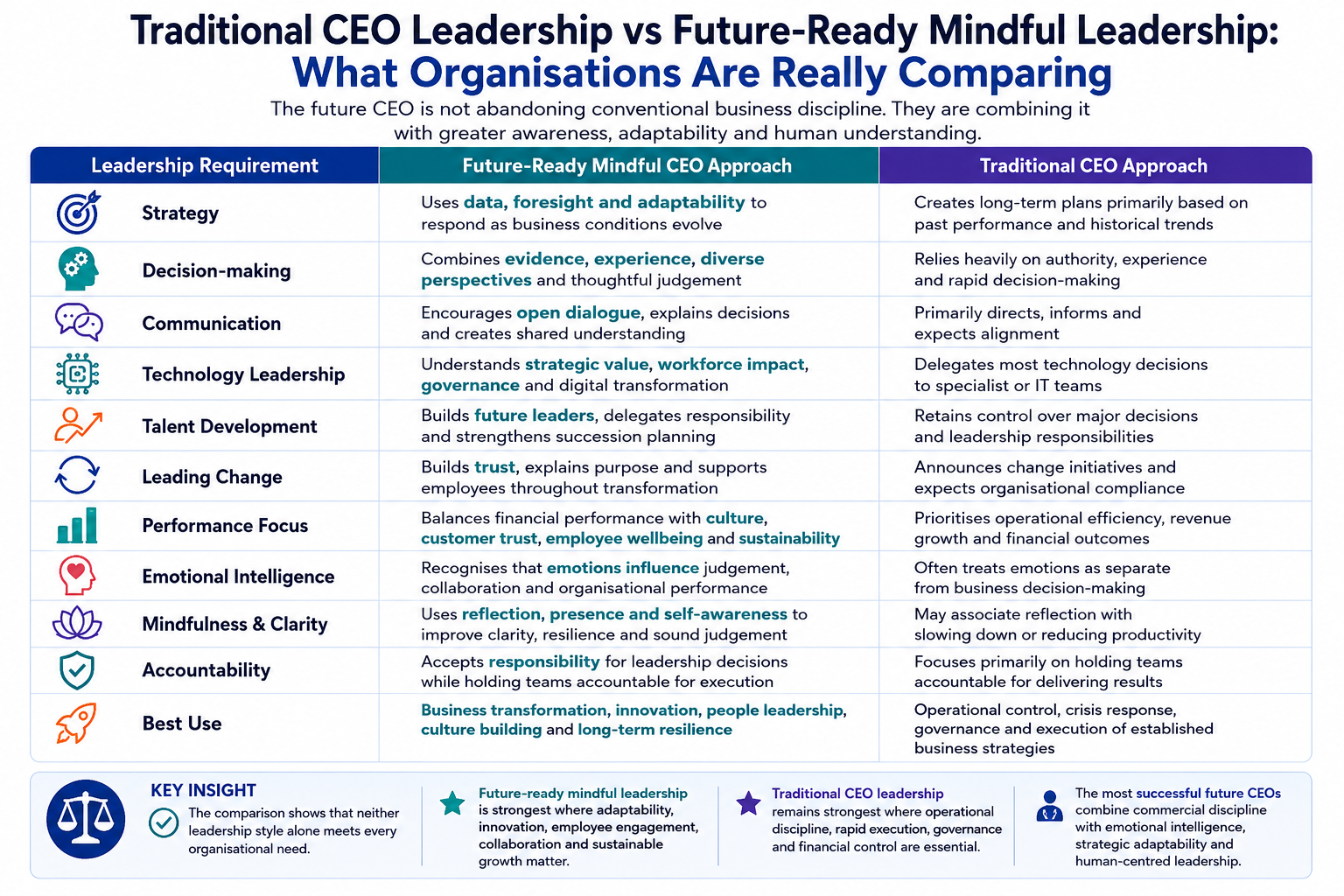
The traditional image of a CEO focused mainly on revenue, operations and shareholder returns is no longer sufficient.
Today’s chief executives must manage technological disruption, workforce uncertainty, customer expectations, public accountability and rapid changes in the competitive environment. They are expected to understand artificial intelligence, attract capable people, maintain trust and make decisions before every fact is available.
The World Economic Forum estimates that 39% of workers’ existing skills may change or become outdated between 2025 and 2030. Employers continue to prioritise analytical thinking, resilience, flexibility, leadership and social influence while technology-related skills grow rapidly.
PwC’s 2026 CEO and workforce research similarly indicates that AI-led reinvention is increasing pressure on organisations. Leaders must align strategy, skills and employee trust rather than treating technological adoption as a stand-alone project.
This means future CEOs cannot rely entirely on past experience.
Experience remains valuable, but it must be combined with curiosity, self-awareness and the ability to adapt. The leader who believes yesterday’s answers will solve tomorrow’s problems may create confidence without direction.
The following leadership skills will help future CEOs remain commercially effective without losing the human judgement their organisations still require.
Leadership Skill 1: Strategic Thinking
Strategic thinking is a key part of business consulting services, helping leaders see beyond immediate activity and understand how decisions affect the organisation over time.
A future CEO must constantly examine:
- Where the market is moving
- What customers will need next
- Which capabilities the company must build
- What competitors may overlook
- Which opportunities deserve investment
- Which activities no longer support the strategy
Strategic thinking is not the same as preparing a long presentation or annual plan. It requires making meaningful choices.

A company cannot treat every customer group, opportunity and new idea as equally important. Resources are limited. Strong leaders decide where the organisation will focus and what it will deliberately avoid.
Mindfulness supports strategic thinking because it reduces the urge to respond immediately to every new development. A mindful CEO can pause, distinguish urgency from importance and ask whether an attractive opportunity genuinely supports the company’s direction.
Without that pause, strategy can easily become a series of reactions to competitors, investors or short-term market pressure.
Leadership Skill 2: Self-Awareness
A CEO’s strengths influence the organisation. So do their blind spots.
Self-aware leaders understand how their behaviour affects employees, and personal development programmes help strengthen this capability. They recognise their preferred communication style, emotional triggers, decision-making habits and areas where they need stronger expertise.

A leader who believes they are “direct” may be experienced by employees as dismissive. A leader who sees themselves as highly involved may have created a culture where nobody acts without permission.
Self-awareness allows leaders to ask:
- Do people feel safe disagreeing with me?
- Am I listening or waiting to speak?
- Which decisions am I avoiding?
- Where has confidence become rigidity?
- What responsibilities should I delegate?
- How does my mood affect the room?
Mindfulness is especially relevant here. It trains leaders to observe thoughts and emotional responses without immediately defending or acting on them.
This does not make a CEO passive. It makes them more conscious of what is driving their response through coaching and counselling support.
A leader who can notice frustration before speaking has a better chance of addressing the issue without damaging trust.
Leadership Skill 3: Emotional Intelligence
Emotional intelligence includes recognising emotions, managing one’s reactions, understanding other people and handling relationships constructively.
CEOs need this skill because organisations are emotional environments, even when discussions appear entirely commercial.
A merger may create fear. Restructuring may generate resentment, making workplace mental wellness increasingly important.Rapid growth may overwhelm managers. A new strategy may challenge employees who were successful under the previous model.
The CEO must acknowledge these realities without allowing every emotion to dictate the company’s direction.
Emotionally intelligent leaders can:
- Communicate difficult decisions respectfully
- Recognise tension before it becomes conflict
- Respond without humiliating people
- Separate behaviour from personal identity
- Adapt communication for different audiences
- Remain calm during uncertainty

Emotional intelligence does not mean avoiding accountability. It means delivering accountability in a way that preserves dignity and encourages improvement.
Mindful leadership adds a vital layer: the ability to remain present while another person is speaking rather than mentally preparing a defence or solution.
Leadership Skill 4: Clear and Persuasive Communication
A strong strategy has little value when employees cannot understand it.
Future CEOs must communicate with investors, employees, customers, partners, regulators and the public. Each audience may require different information, but the central direction should remain consistent.

Effective CEO communication explains:
- What is changing
- Why the change matters
- What will remain consistent
- What employees are expected to do
- How progress will be measured
- What leadership does not yet know
Clarity builds confidence. False certainty weakens it.
A CEO does not need to have every answer. However, they should be honest about uncertainty and explain how the organisation will respond as new information becomes available.
Mindfulness at the workplace improves communication by encouraging deliberate speech. Instead of filling silence, the leader creates enough space to frame the message properly.
A short pause before answering a difficult question often communicates confidence more effectively than a fast, defensive response.
Leadership Skill 5: Decisiveness Under Uncertainty
CEOs are rarely presented with perfect information.
They must decide whether to enter a market, launch a product, replace a system, hire a senior leader or change the business model while important variables remain uncertain.
Poor leaders commonly fall into one of two patterns:
- Acting quickly without sufficient thought
- Delaying repeatedly while waiting for certainty
Strong decision-making sits between these extremes.
A future CEO should be able to determine:
- What decision must be made?
- What information is genuinely necessary?
- What assumptions are being made?
- What risks can be reduced?
- What would make the decision reversible?
- When does further delay become more costly than action?

Mindfulness supports better decisions by helping the leader recognise fear, ego and urgency without allowing them to dominate the process.
A calm decision is not necessarily a slow decision. It is one made with awareness of both evidence and emotion.
Leadership Skill 6: Adaptability and Resilience
Change is no longer an occasional interruption. It is a permanent condition of leadership.
CEOs must adapt to technological change, economic pressure, shifting customer expectations, regulatory developments and new workforce models.

The World Economic Forum identifies resilience, flexibility and agility among the core capabilities expected to remain critical as jobs and industries evolve.
Adaptability does not mean changing direction every time circumstances move. That creates confusion.
It means holding firmly to the organisation’s purpose while remaining flexible about how it will achieve it.
Resilient leaders:
- Recover after setbacks
- Learn from failed initiatives
- Adjust plans without assigning unnecessary blame
- Protect the team from avoidable panic
- Maintain perspective during difficult periods
- Continue making thoughtful decisions under pressure
Mindfulness creates resilience by helping leaders remain grounded in the present rather than becoming consumed by worst-case scenarios.
It does not remove difficulty. It improves the leader’s ability to meet difficulty without losing clarity.
Leadership Skill 7: Talent Development and Delegation
A CEO who must personally solve every important problem has not built a scalable organisation.
Future CEOs need the ability to identify capable people, develop leadership capacity and transfer meaningful responsibility.
Delegation is not simply assigning tasks. It includes giving someone:
- A clear outcome
- Appropriate authority
- Access to information
- Defined boundaries
- Support without constant interference
- Accountability for results

Many founders struggle with delegation because their original success came from personal involvement. As the company grows, that involvement can become the obstacle.
Talent development requires patience. Employees may not initially make decisions exactly as the CEO would. The goal is not to create copies of the CEO but to develop responsible leaders who can think independently.
Mindful CEOs notice when control is being driven by anxiety rather than necessity.
They also listen more carefully during coaching conversations, making it easier to understand whether someone needs instruction, feedback, encouragement or greater autonomy.
Leadership Skill 8: Technological and AI Literacy
Future CEOs do not need to become software engineers. They do need enough technological understanding to ask intelligent questions and make responsible investment decisions.
AI, automation, data systems and digital platforms increasingly affect strategy, operations and workforce design.

A CEO should understand:
- Where AI can create practical value
- Which processes should not be automated
- How data quality affects results
- What risks relate to privacy, bias and security
- How technology will change employee roles
- Which outcomes should justify the investment
Technological literacy prevents two leadership failures: rejecting useful innovation out of fear and adopting technology without a valid business case.
PwC’s current research emphasises that AI value depends on redesigning work, skills and roles alongside deployment. Leaders must address trust and workforce readiness rather than assuming the technology alone will produce transformation.
Mindfulness helps leaders remain curious without becoming impulsive. They can explore emerging tools while continuing to question whether those tools serve the organisation and its people.
Leadership Skill 9: Ethical Judgement and Accountability
CEOs shape what the organisation considers acceptable.
Employees pay attention not only to formal policies but also to which behaviours leaders reward, ignore or excuse.
Ethical leadership requires consistency between what the organisation says and what it does.
Future CEOs will face difficult questions involving:
- Customer data
- Artificial intelligence
- Employee surveillance
- Environmental impact
- Workforce restructuring
- Supplier standards
- Public communication
- Conflicts of interest

Legal compliance is the minimum requirement. Ethical judgement asks whether a decision is responsible, transparent and aligned with the organisation’s stated values.
Accountable leaders accept responsibility when decisions produce poor outcomes. They do not hide behind committees, algorithms or junior employees.
Mindfulness helps reveal moments when convenience, ambition or fear is influencing judgement. It creates room to consider who may be affected, not only what the company is technically permitted to do.
Leadership Skill 10: The Ability to Build Trust
Trust is one of the CEO’s most valuable forms of organisational capital.
Employees are more likely to accept difficult change when they trust leadership’s intentions and competence. Customers are more likely to remain loyal when the company behaves consistently. Partners are more willing to collaborate when commitments are honoured.

Trust develops through repeated behaviour:
- Communicating honestly
- Following through on promises
- Admitting mistakes
- Treating people consistently
- Explaining difficult decisions
- Avoiding manipulation
- Listening to concerns
- Acting in line with declared values
Trust is slow to build and easy to damage.
A future CEO cannot delegate trust entirely to HR, communications or brand teams. The leader’s own conduct becomes evidence of what the organisation represents.
Mindful leadership strengthens trust because it improves presence. People can usually tell when a leader is distracted, rehearsed or responding automatically. Genuine attention communicates respect.
How Future CEOs Can Develop These Leadership Skills
Leadership skills improve through practice, feedback, SMART goal setting, and reflection—not job titles alone
Ask colleagues, mentors and team members how your behaviour affects them. Avoid asking only whether you are a “good leader.” Request specific examples involving communication, delegation and decision-making.
Before important meetings or decisions, take a few minutes to slow your breathing and identify the desired outcome.
During conversations, pause before responding to disagreement. This small habit can reduce defensive reactions.
Record difficult decisions, assumptions, emotions and results. Over time, patterns will become visible.
Give capable people responsibility for results and allow them to determine appropriate methods within agreed boundaries.
Learn enough about AI, data, cybersecurity and automation to evaluate strategic implications. Do not outsource all understanding to vendors.
No CEO can see every risk clearly. Build relationships with people who have different expertise, backgrounds and perspectives.
Leadership workshops, executive coaching and corporate training can provide frameworks, practice and accountability that daily experience alone may not offer.
Common Objections to Mindful Leadership
A mindful pause may take only a few seconds. It can prevent hours of confusion created by an impulsive response or poorly framed decision.
Mindfulness is not avoidance. It improves awareness and emotional control, allowing leaders to address difficult issues directly without unnecessary aggression.
Experience teaches only when the leader reflects on it. Someone can repeat the same ineffective behaviour for twenty years and call it experience.
Technical knowledge is valuable, but CEOs achieve results through people. Strategy fails when employees do not understand, trust or execute it.
Pretending to know what is uncertain damages trust. Strong leaders can communicate confidence in the process without claiming to possess every answer.
Frequently Asked Questions
What are the most important leadership skills for a future CEO?
Strategic thinking, communication, emotional intelligence, adaptability, decision-making, delegation, talent development, technological literacy, ethical judgement and trust-building are among the most important.
Why are leadership skills important for CEOs?
CEOs influence strategy, culture, performance and public trust. Their behaviour affects how quickly the organisation makes decisions and adapts to change.
Can leadership skills be learned?
Yes. Leadership skills develop through practice, feedback, coaching, training and reflection. Natural confidence alone does not guarantee effective leadership.
How does mindfulness improve leadership?
Mindfulness helps leaders notice thoughts, emotions and assumptions before reacting. This can improve listening, decision-making, communication and resilience.
Does a CEO need technical expertise in AI?
A CEO does not need advanced coding skills but should understand AI’s business uses, risks, workforce impact and governance requirements.
What is the difference between management and leadership?
Management focuses on planning, coordination and execution. Leadership creates direction, builds trust and helps people move towards a shared objective. Effective CEOs need both.
How can future CEOs improve emotional intelligence?
They can request feedback, practise active listening, study their emotional triggers, pause before responding and work with a coach or mentor.
Why is delegation difficult for emerging CEOs?
Delegation can feel risky because leaders fear losing quality or control. Clear outcomes, boundaries and accountability make delegation more effective.
What is mindful leadership?
Mindful leadership combines attention, self-awareness and deliberate action. It allows leaders to remain present and respond thoughtfully rather than automatically.
When should an organisation invest in leadership development?
Leadership development is valuable before expansion, succession, restructuring or major transformation—and whenever managers struggle with communication, accountability or team engagement.
Conclusion: Future CEOs Must Lead Themselves Before They Can Lead an Organisation
The future CEO will operate in an environment where technology moves quickly, workforce expectations evolve and business decisions carry wider consequences.
Technical knowledge and commercial ambition will remain important, but they will not be enough. The leaders who create sustainable organisations will be those who can think clearly, communicate honestly, develop capable people and remain grounded under pressure.
Mindfulness connects these leadership skills. It helps future CEOs slow down enough to notice what others miss while remaining decisive enough to move the organisation forward.
To strengthen leadership capability within your organisation, explore Litos’ Corporate Training programmes, Business Consulting services, Personal Development programmes, Coaching and Counselling support, and guidance on mindfulness in the workplace. You can also contact the Litos team to discuss leadership training, executive development, or customised programmes aligned with your organisation’s goals.