
Facebook vs LinkedIn Marketing: Which Platform Is Right for Your Business?
Quick Summary
Facebook and LinkedIn can both help businesses build visibility, attract prospects and generate leads, but people use the two platforms with very different intentions.
Facebook is generally stronger for broad consumer reach, community building, local visibility, visual storytelling, remarketing and businesses where personal interests influence buying decisions. LinkedIn provides a professional environment where businesses can reach decision-makers, establish expertise, develop thought leadership and generate B2B opportunities.
The question, therefore, is not simply whether Facebook or LinkedIn marketing is better.
Businesses need to ask where their target audience spends time, why they use each platform, what type of buying decision they are making and what the business expects social media to achieve.
For many companies, the strongest answer is not Facebook or LinkedIn. It is using each platform for the role it performs best.
Facebook vs LinkedIn Marketing: The Audience May Overlap, but Their Intent Does Not
The same managing director who researches suppliers on LinkedIn may spend the evening browsing Facebook, participating in a community group or looking at recommendations from friends.
The person has not changed.
Their mindset has.
That difference is fundamental to understanding Facebook vs LinkedIn marketing.
People generally enter LinkedIn expecting professional conversations. They follow industry developments, evaluate expertise, build networks, research organisations and engage with business-related content.
Facebook is broader. People use it to maintain relationships, participate in communities, follow interests, discover businesses, watch videos and interact with local organisations and brands.
Neither environment is automatically better for marketing.
The more useful question is:
What state of mind do you want your customer to be in when they encounter your business?
A leadership consultant trying to reach HR directors may find LinkedIn highly relevant.
A restaurant, wellness centre, home improvement company or consumer brand may find Facebook much more useful.
A training company selling corporate programmes while also running public workshops may need both.
Marketing Strategy Solutions should begin with customer behaviour rather than assumptions about which social network is currently receiving the most attention.
What Is Facebook Marketing?
Facebook marketing involves using a business Page, organic content, communities and paid advertising to build awareness, engagement and customer action. Businesses can also use Facebook Marketing Services to manage these activities strategically.
Businesses can use Facebook for:
- Brand awareness
- Local business visibility
- Educational content
- Video and Reels
- Customer stories
- Community engagement
- Events
- Lead-generation campaigns
- Website traffic
- Remarketing
- Offers and promotions
- Customer conversations

One of Facebook’s greatest strengths is the breadth of its audience.
A person does not need to identify themselves professionally before becoming relevant to a business. They can be reached according to interests, behaviours, engagement and previous interaction with the brand.
This makes Facebook particularly useful when the purchasing decision is influenced by lifestyle, personal need, family, location, interests or emotional connection.
It can also help businesses stay visible over a longer consideration period.
Someone may watch a video today, interact with another post next week and visit the website later. Paid remarketing can help the business continue that relationship rather than expecting every piece of content to generate an immediate enquiry.
Facebook marketing works particularly well when businesses understand that social media is not simply an advertising board.
People expect useful, interesting or relatable content before they want another sales message.
What Is LinkedIn Marketing?
LinkedIn marketing uses professional profiles, company Pages, content, networking and advertising to reach people in a business context. LinkedIn Marketing Services can help businesses build visibility, reach relevant professionals and generate B2B opportunities.

It is particularly relevant for:
- B2B organisations
- Consultants
- Professional service providers
- Corporate trainers
- Technology companies
- Recruiters
- Business coaches
- Agencies
- Founders and executives
- Enterprise solution providers
LinkedIn allows businesses to build visibility around expertise rather than simply products.
A consultant can explain an industry problem. A CEO can share a perspective on changing customer behaviour. A company can publish a case study. A subject-matter expert can challenge an accepted industry assumption.
These activities gradually build professional credibility.
That matters because many B2B decisions involve significant risk.
A buyer considering a consultant, agency, software system or corporate training provider is rarely evaluating only the service. They are also evaluating the people behind it.
Current LinkedIn research reflects this shift towards trusted professional voices, creator-led content and video. Thought leadership is increasingly connected to how B2B buyers discover expertise and validate potential suppliers.
LinkedIn therefore works best when businesses stop treating it as an online brochure and begin treating it as a professional conversation.
Where Facebook Marketing Has a Clear Advantage
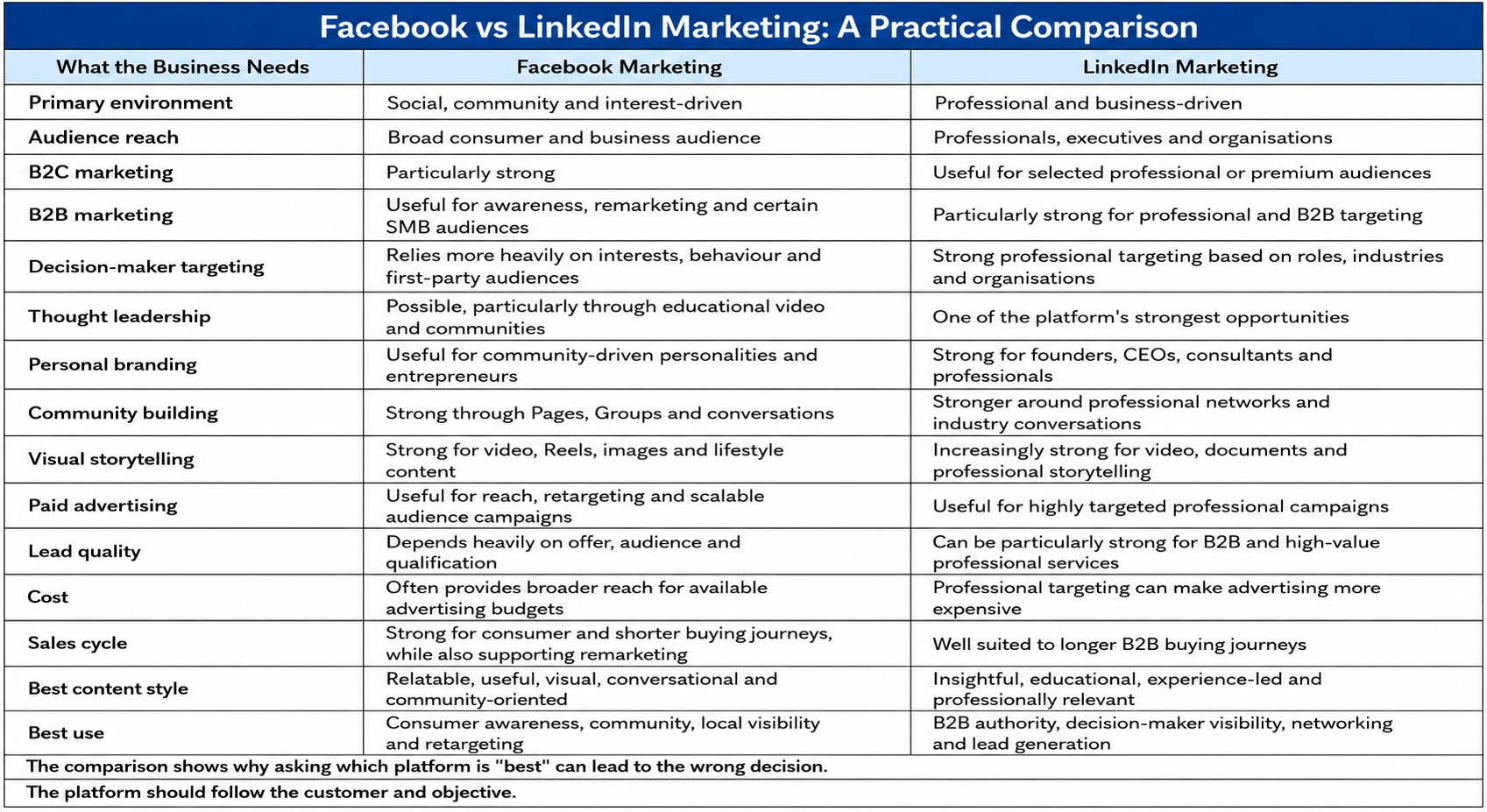
Facebook allows businesses to reach people across a wide variety of demographics, interests and life stages.
This is particularly useful for businesses whose customers cannot easily be defined by job title.
Facebook Groups and community-oriented content allow brands to create conversations around shared interests.
A parenting brand, fitness coach, local business or educational provider may develop a highly engaged audience without requiring every interaction to begin with a purchase.
Businesses selling directly to consumers can use location, interest and behavioural signals alongside engaging content to remain visible.
Local businesses can also reinforce their broader search presence by maintaining consistent business information, reviews and useful social activity.
A visitor who leaves your website without enquiring has not necessarily rejected the business.
Facebook can help reconnect with previous website visitors, content viewers or engaged audiences through paid campaigns.
Facebook naturally accommodates video, photographs, customer stories, events and behind-the-scenes content.
This makes it useful when emotion and visual demonstration influence the buying decision.
Where LinkedIn Marketing Has a Clear Advantage
LinkedIn’s central advantage is context.
People identify themselves through their work, skills, companies, industries and professional interests.
For B2B marketers, this can make it easier to build campaigns around relevant professional audiences.
LinkedIn reports that 89% of B2B marketers use the platform for lead generation, while 62% say it generates leads for them.
Selling a business service often means reaching a very specific person.
The customer may not be “businesses in Bangalore.”
It may be:
- HR directors at companies with 500+ employees
- Marketing heads in technology companies
- Founders of funded startups
- Procurement professionals
- Learning and development managers
- CEOs of growing SMEs
LinkedIn is designed around this professional information.
High-value B2B buyers frequently need confidence before initiating a sales conversation.
Consistent insight helps create that confidence.
A founder or subject-matter expert who regularly discusses real industry problems can become familiar to potential customers long before an enquiry is made.
People increasingly want to understand who is behind the company.
LinkedIn allows founders and executives to build professional visibility through Personal Branding Services alongside the corporate brand.
For service businesses, this can be particularly powerful because the person’s expertise is often part of what the customer is purchasing.
B2B purchases may involve multiple people and several stages.
LinkedIn’s recent marketing developments increasingly focus on company-level engagement, buying groups, pipeline influence and attribution rather than treating every lead as an isolated individual.
This makes the platform particularly relevant when the buying journey extends beyond a simple form submission.
Organic Facebook vs Organic LinkedIn: What Should You Post?
Businesses frequently make the mistake of publishing exactly the same content everywhere.
Efficiency matters, but copy-and-paste distribution ignores platform context.
Facebook Content Should Often Include:
- Short educational videos
- Reels
- Customer stories
- Behind-the-scenes content
- Questions
- Community discussions
- Events
- Practical tips
- Testimonials
- Relatable business stories
- Visual demonstrations
LinkedIn Content Should Often Include:
- Industry observations
- Founder perspectives
- Case studies
- Professional lessons
- Contrarian viewpoints
- Educational carousels
- Data interpretation
- Client problems and solutions
- Leadership insights
- Original frameworks
- Professional video
The core idea can remain the same. The presentation should change, and Content Creation and Video Services can help adapt the same idea for each platform.
For example, a business consulting firm could discuss employee burnout on both platforms.
On Facebook, the content might ask employees to recognise five signs they are approaching burnout.
On LinkedIn, the same topic could examine what managers should change when burnout becomes a team-level pattern.
One subject. Different audience mindset.
Facebook Ads vs LinkedIn Ads: Which Should You Choose?
Digital Marketing Services and advertising decisions should begin with economics rather than platform loyalty.
Ask:
Who must see this advertisement for the campaign to succeed?
Facebook’s broad reach can make it useful for awareness, consumer campaigns, remarketing and offers with a relatively large potential audience.
LinkedIn’s professional targeting can justify higher acquisition costs when reaching the right decision-maker is more important than reaching a large number of people.
For example, spending more to reach 100 relevant HR directors may make sense when one corporate contract is worth several lakhs.
The same economics may not make sense for a low-cost consumer product.
Businesses should compare:
- Cost per qualified lead
- Lead-to-meeting rate
- Meeting-to-sale conversion
- Customer acquisition cost
- Average deal value
- Sales-cycle length
- Lifetime customer value
Cheap leads are not automatically good leads.
Expensive leads are not automatically valuable either.
Measure what happens after the form is completed.
The Strongest Strategy May Be Facebook AND LinkedIn
Businesses with several audiences should not necessarily choose one platform.
Instead, each platform can perform a different role.
Consider a corporate training company.
LinkedIn could:
Build the founder’s professional authority.
Reach HR and learning and development leaders.
Publish leadership insights.
Share corporate case studies.
Generate conversations with decision-makers.
Facebook could:
Promote public workshops.
Build community.
Share videos and testimonials.
Reach individual professionals.
Retarget website visitors.
Promote events.
Together, the platforms create multiple paths into the business.
A potential corporate buyer may first encounter a founder’s LinkedIn post, visit the website and later see a Facebook remarketing campaign.
Another customer may discover a Facebook video and subsequently review the founder’s LinkedIn profile before making contact.
Modern marketing journeys rarely remain inside one platform.
How to Decide Between Facebook and LinkedIn Marketing
Begin with six questions.
1. Who Exactly Are You Trying to Reach?
Do not answer “business owners” or “working professionals.”
Define the audience precisely.
2. Is the Purchase Primarily Personal or Professional?
The same person behaves differently depending on the context of the decision.
3. Who Makes the Final Decision?
A consumer may decide independently.
A corporate purchase may involve managers, finance, procurement and senior leadership.
4. What Is the Value of the Sale?
Higher-value sales can justify more expensive professional targeting when it produces better-qualified opportunities.
5. What Kind of Content Can You Sustain?
A platform strategy that requires content your team cannot consistently produce will eventually fail.
6. What Happens After Someone Engages?
Social media should connect to a wider system.
That may include:
Website → Lead magnet → Email → Consultation
or:
Social post → Retargeting → Landing page → Enquiry
Do not evaluate Facebook or LinkedIn purely by likes and followers.
Evaluate their contribution to the customer journey.
Common Objections to Facebook and LinkedIn Marketing
No.
Facebook can support B2B awareness, founder visibility, community and remarketing. However, LinkedIn generally provides a more natural professional environment for reaching specific B2B decision-makers.
LinkedIn advertising can cost more because professional targeting is highly specific.
The relevant question is whether the resulting opportunities justify the cost.
A higher cost per lead may still produce better economics if those leads are significantly more likely to become valuable customers.
Not necessarily.
Maintaining five weak social channels rarely creates more authority than building two strong ones.
Choose platforms based on audience behaviour and business goals.
You can reuse the underlying idea.
You should adapt the hook, examples, format and CTA to the environment.
Repurposing is efficient. Blind duplication is not.
Not every post will generate an enquiry.
Organic content often performs an earlier role by building familiarity, credibility and trust.
When a prospect eventually needs the service, that accumulated visibility can influence which businesses they consider.
Frequently Asked Questions
Is Facebook or LinkedIn better for marketing?
Neither platform is universally better. Facebook is generally stronger for broad reach, consumer audiences, communities, visual storytelling and remarketing. LinkedIn is particularly strong for B2B marketing, professional targeting, thought leadership and reaching decision-makers.
Is LinkedIn better than Facebook for B2B marketing?
LinkedIn usually offers stronger B2B targeting because users provide professional information such as job roles, industries and companies. Facebook can still support B2B campaigns through awareness, content distribution and remarketing.
Is Facebook still effective for business marketing?
Yes. Facebook remains useful for consumer marketing, community building, local businesses, video content, events and retargeting. Effectiveness depends on the audience and objective.
Which platform is better for lead generation?
For B2B services, LinkedIn can provide highly relevant professional leads. Facebook can generate leads efficiently for consumer services and broader audiences. Businesses should measure lead quality and conversion rather than lead volume alone.
Which is better for personal branding?
LinkedIn is particularly effective for CEOs, founders, consultants and professionals building authority around their expertise. Facebook can be valuable when the personal brand is community, lifestyle or consumer focused.
Should a small business use Facebook or LinkedIn?
A small business should choose according to its customer. A local consumer business may prioritise Facebook. A B2B consultant may prioritise LinkedIn. A business serving both markets may use each differently.
Can I use the same social media content on Facebook and LinkedIn?
The core idea can be repurposed, but content should be adapted. Facebook generally rewards relatable and community-oriented communication, while LinkedIn audiences expect professional relevance and insight.
Should CEOs post on LinkedIn or the company Page?
Ideally both can contribute. The company Page establishes organisational presence while the CEO or founder can provide perspective, expertise and a recognisable human voice.
Are Facebook Ads cheaper than LinkedIn Ads?
Facebook often provides broader reach at a lower advertising cost, while LinkedIn's professional targeting can command higher costs. Campaign economics should be judged by qualified opportunities and revenue rather than clicks alone.
How often should businesses post?
There is no universal number. Consistency and content quality matter more than publishing simply to meet a quota. Choose a schedule your team can sustain while continuing to produce useful content.
Conclusion: Follow the Customer, Not the Platform Trend
The Facebook vs LinkedIn marketing decision becomes much easier when businesses stop asking which platform is more popular and start examining how their customers actually make decisions.
Facebook offers broad reach, community, visual storytelling and powerful opportunities to remain visible to consumers and previous visitors.
LinkedIn provides professional context, decision-maker targeting, thought leadership and a strong environment for B2B relationships.
Some businesses clearly need one more than the other.
Others need both.
The important part is giving each platform a defined purpose within the wider customer journey rather than publishing everywhere and hoping attention turns into business.
To build a social media strategy around the platforms your customers actually use, explore Litos’ Facebook Marketing Services, LinkedIn Marketing Services, Digital Marketing Services, Marketing Strategy Solutions, Content Creation and Video Services, and Personal Branding Services. You can also contact the Litos team to develop a platform-specific marketing strategy aligned with your target audience, budget, and business goals.