
AI vs Traditional Marketing: Stop Choosing Sides—Build a Smarter Growth System

Quick Summary
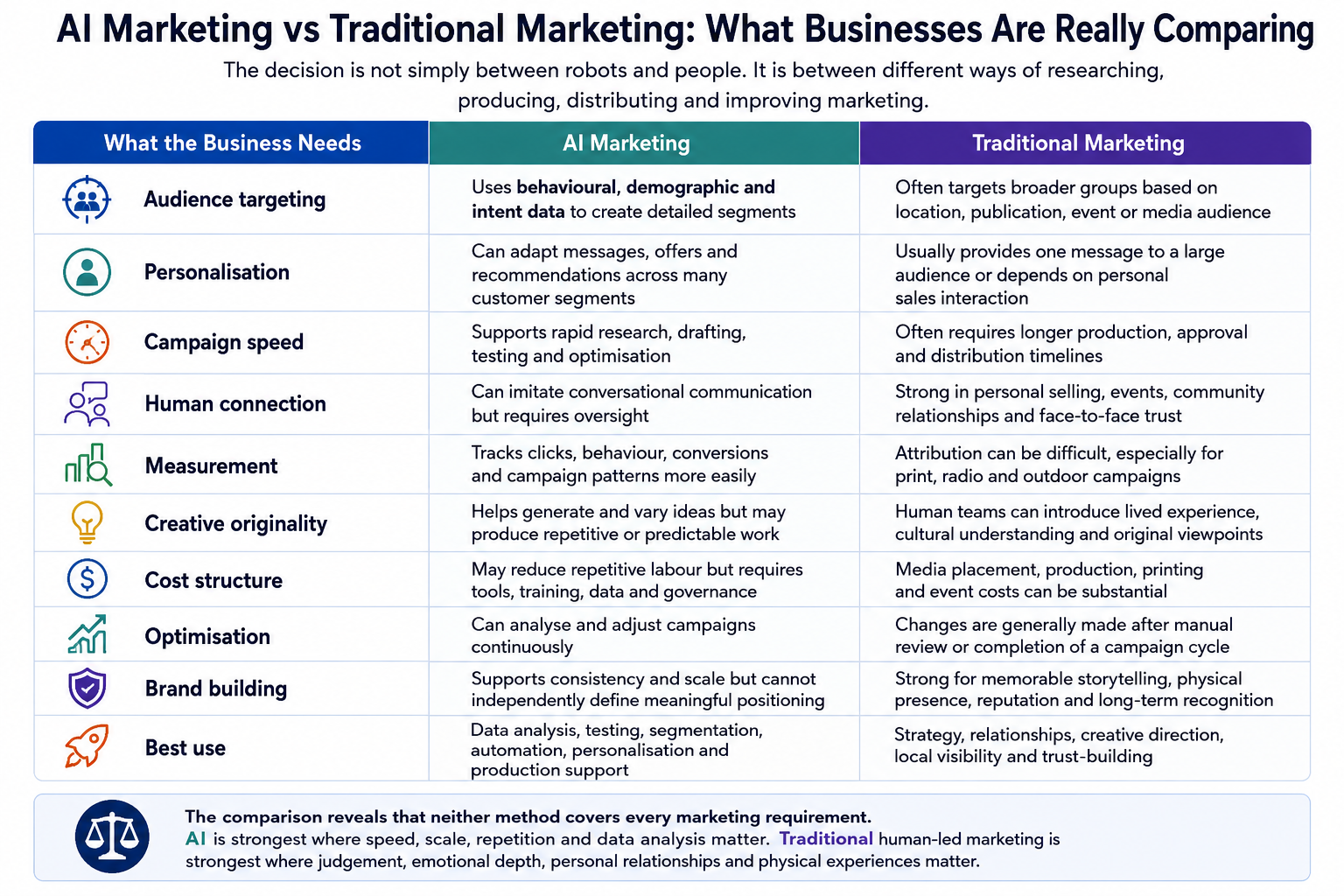
AI marketing helps businesses analyse data, personalise communication, automate repetitive work and optimise campaigns faster. Traditional marketing contributes human insight, emotional storytelling, physical visibility, relationships and long-term brand recognition.
The better question is not whether AI or traditional marketing will win. It is which responsibilities should be handled by technology, which require human judgement, and how both can work together to produce sustainable business growth.
For most organisations, the strongest strategy is a hybrid model: people define the audience, positioning, message and ethical boundaries, while AI supports research, execution, testing, personalisation and performance analysis.
AI Marketing Is Changing the Process, Not the Purpose of Marketing
Marketing has always been about understanding people, communicating value and helping the right customer make a decision. Artificial intelligence has not changed that purpose. It has changed how quickly and efficiently many digital marketing solutions can be planned, executed and optimised.
AI can examine large amounts of customer information, identify patterns, suggest content topics, create first drafts, segment audiences, recommend advertising adjustments and automate follow-up communication. Tasks that once required several employees and many hours can now be supported by a collection of well-chosen AI tools.
Adoption is already widespread. HubSpot reported in 2025 that 66% of the marketers it surveyed were using AI in their work. Salesforce’s global marketing research similarly identifies generative and predictive AI as increasingly mainstream, while noting that many businesses still struggle to activate their data effectively.
However, faster execution does not automatically create better marketing.
AI can produce ten advertisements quickly, but it cannot guarantee that the central promise is persuasive. It can draft a month of social media posts, but it cannot independently decide what a brand should stand for. It can detect customer patterns, but those patterns still need interpretation.
AI amplifies the strategic marketing planning it receives.When the strategy is clear, it can improve efficiency. When the strategy is confused, it allows a business to produce and distribute that confusion much faster.
What Is Traditional Marketing?
Traditional marketing generally refers to established promotional approaches that rely heavily on human planning, manual execution and broad audience communication.
It can include:
- Newspaper and magazine advertisements
- Television and radio commercials
- Flyers, brochures and direct mail
- Billboards and outdoor advertising
- Exhibitions, conferences and networking events
- Sponsorships and community partnerships
- Telemarketing and personal selling
- Human-led branding, content and campaign development

Traditional marketing is sometimes described as outdated simply because many of its channels existed before digital marketing. That view is too simplistic.
A well-placed billboard can build local recognition. A memorable event can create relationships that no automated funnel can replicate. A printed brochure can carry credibility during a high-value sales conversation. A personal recommendation can influence a buyer more strongly than a perfectly targeted advertisement.
The greatest strengths of traditional marketing are often its human and physical qualities. It can make a business feel established, visible and connected to a community.
Its limitations are usually related to cost, speed, measurement and personalisation. A newspaper advertisement reaches every reader in the same way. A printed brochure cannot automatically change according to the recipient’s interests. Campaign results may also be difficult to connect directly to individual sales.
What Is AI Marketing?
AI marketing is the use of artificial intelligence to support marketing research, decisions, execution and optimisation.

It is not one tool or one platform. It can involve several technologies and use cases, including:
- Customer and competitor research
- Audience segmentation
- Predictive lead scoring
- Content ideation and drafting
- Email personalisation
- Chatbots and conversational support
- Advertising optimisation
- Social listening and sentiment analysis
- Recommendation engines
- Marketing automation
- Customer behaviour analysis
- Reporting and performance forecasting
AI marketing differs from basic automation.
A conventional automation may send the same email whenever someone completes a form. An AI-supported system may analyse the person’s behaviour, classify their likely interest and recommend a more relevant message or next step.
AI is particularly useful when a business has large amounts of information, repeated marketing processes or several audience segments. It can help teams find patterns and respond faster than they could manually.
Nevertheless, its results depend on the quality of the data, instructions and supervision it receives. Incomplete data produces incomplete conclusions. Generic prompts produce generic content. Poorly controlled automation can send inappropriate messages at scale.
Where AI Marketing Has a Clear Advantage
AI can significantly shorten the early stages of campaign production. It can help marketers organise customer feedback, summarise research, identify recurring questions and produce multiple starting concepts.
This does not eliminate the need for research. It reduces the time required to process and apply it.
A salesperson may adapt a conversation for one prospect. AI-supported marketing systems can help adapt content or recommendations for hundreds or thousands of people based on their behaviour.
This is especially useful for ecommerce, online education, software services and businesses with multiple customer groups.These experiences are most effective when supported by reliable website development services that improve user experience and conversions.
Traditional campaign teams may create and compare two versions of an advertisement. AI can support the creation and analysis of several headlines, offers, formats or audience combinations.
The marketer must still decide which variables are meaningful. Testing everything without a clear hypothesis creates noise rather than insight.
Many businesses possess customer information but do not know how to use it. AI can help identify purchasing patterns, repeated objections, likely customer groups and declining engagement.
Salesforce’s research notes that although many marketers have access to real-time data, activating it remains a challenge. This means the opportunity is not merely to buy an AI platform but to connect data, strategy and execution properly.
AI can prepare first drafts, resize or repurpose content, classify leads and assist with reporting. This gives marketing professionals more time for strategic thinking, customer conversations and creative refinement.
The goal should not be to remove people from marketing. It should be to remove avoidable manual work from their day.
Where Traditional Marketing and Human Judgement Still Win
AI can follow a positioning strategy, but it should not be responsible for inventing a company’s identity without informed human direction.
A meaningful brand is shaped by customer understanding, organisational values, commercial goals, competitive realities and the experience the business wants to create.
High-value services are often sold through credibility and trust. Workshops, consultations, networking events, referral partnerships and personal conversations remain powerful because customers can evaluate the people behind the business.
AI may support those relationships, but it cannot replace genuine professional accountability.
Language can be grammatically correct and still be culturally inappropriate. A campaign may contain the right keywords but the wrong emotional tone.
Experienced marketers recognise sensitivities, humour, regional differences, social context and unspoken customer concerns that may not be visible in raw data.
AI can organise existing information well. Strong thought leadership requires a position supported by a clear personal branding strategy.
Businesses can strengthen these efforts through professional content creation and video services that communicate expertise consistently across channels.
It comes from experience, observations, disagreement, professional judgement and lessons learned while solving real problems. Without these inputs, AI-generated content often sounds polished but interchangeable.
Events, workshops, print materials, local partnerships and community participation can provide credibility that a purely digital strategy may not achieve.
For businesses selling to local communities, educational institutions or corporate teams, offline presence can reinforce online visibility rather than compete with it.
The Winning Model: Human Strategy Supported by AI
The most effective approach is not to divide the marketing department into an AI side and a traditional side.
It is to define a connected process.This integrated approach strengthens marketing and business development by combining human expertise with AI capabilities.
- Brand positioning
- Customer understanding
- Offer development
- Creative direction
- Ethical decisions
- Relationship building
- Final approvals
- Strategic interpretation
- Research organisation
- Audience segmentation
- Content drafts
- Campaign variations
- Data analysis
- Repetitive workflows
- Personalisation
- Performance reporting
This combination preserves the qualities that make marketing credible while improving the speed at which teams can act.
Research also shows that adoption does not guarantee results. Gartner reported that 27% of surveyed CMOs had limited or no generative-AI adoption, while many adopters remained concerned about measurable returns. The lesson is important: technology must be introduced around a valid business case, not because competitors appear to be using it.
How to Decide What Your Business Should Automate
Begin with the problem, not the tool.
Ask:
- Which marketing activities consume the most time?
- Which tasks are repetitive and rule-based?
- Where are customers waiting too long for a response?
- Which decisions would improve with better data?
- Where is human interaction central to trust?
- Which activities carry reputational or ethical risk?
- What result will prove that the AI investment is useful?
A small business does not need a complex AI infrastructure on the first day. It may begin by using AI to organise customer research, repurpose approved content and improve reporting.
A larger organisation may introduce lead scoring, dynamic personalisation, predictive analysis and integrated automation.
Businesses that are uncertain where to begin often benefit from business consulting services before investing in AI technologies. Start with a limited pilot. Establish a baseline, choose a measurable goal and review the output regularly. Expand only after the process has demonstrated genuine value.
Common Objections to AI Marketing
It can—especially when it is asked to produce finished content without brand information, examples or editorial review.
The solution is not to reject AI. The solution is to provide clear audience insights, brand guidelines, original expertise and strong human editing.
AI is more likely to change responsibilities than eliminate the need for marketing expertise.
Teams may spend less time producing repetitive first drafts and more time interpreting data, refining ideas, developing offers and building customer relationships.
Traditional marketing does work when the channel suits the buyer and objective. A corporate decision-maker may discover a company online and gain confidence after attending its workshop. A student may see social content and later respond to an on-campus event.
The channels reinforce each other.
This is one of the fastest ways to waste money. Automating an unclear process does not improve it. It simply repeats the problem more efficiently.
Document the process, correct its weaknesses and then decide where AI adds value.
Frequently Asked Questions
Is AI marketing better than traditional marketing?
AI is generally better for speed, data analysis, scalable personalisation and automation. Traditional marketing is often stronger for human relationships, physical visibility, brand experiences and emotional storytelling. Most businesses benefit from using both.
Can small businesses use AI marketing?
Yes. Small businesses can begin with research, content planning, email support, customer segmentation and reporting. They should avoid purchasing a large collection of disconnected tools before defining their priorities.
Does AI-generated content affect brand credibility?
It can when content is inaccurate, repetitive or published without editing. AI-supported content should incorporate original expertise, examples, brand language and human review.
Is traditional advertising becoming obsolete?
No. Print, radio, events, sponsorships and outdoor advertising remain useful in suitable markets. Their effectiveness depends on audience habits, location, campaign objectives and integration with digital channels.
What marketing tasks should not be fully automated?
Sensitive customer communication, crisis responses, strategic positioning, ethical decisions, major creative approvals and high-value relationship management should retain meaningful human oversight.
How should a company measure AI marketing results?
Measure business outcomes rather than content volume. Relevant metrics may include qualified leads, conversion rates, response times, customer acquisition cost, retention, sales-cycle length and revenue contribution.
What is the biggest risk of AI marketing?
The biggest risk is scaling weak strategy, inaccurate information or impersonal communication. Governance, quality control and human accountability are essential.
Should a company hire an AI marketing consultant?
Consultation may be useful when a business is unsure which processes to automate, has several disconnected tools, lacks a clear strategy or needs training and governance before implementation.
Conclusion: The Future of Marketing Is Integrated, Not Automated
AI marketing should not be treated as a replacement for everything businesses already know about customers, creativity and trust. Its real value lies in helping people research more intelligently, execute more efficiently and learn from campaigns more quickly.
Traditional marketing still contributes the judgement, relationships, visibility and emotional understanding that technology cannot generate independently. Businesses that combine these strengths will be better equipped than those that either resist AI completely or automate without a strategy.
To evaluate where AI can improve your current marketing process, explore Litos’ digital marketing solutions, strategic marketing planning, marketing and business development, business consulting services, and content creation and video services. You can also contact the Litos team to discuss a practical marketing system aligned with your audience, available resources, and business goals.