
10 Signs Your Business Needs a Consultant Before Growth Stalls

Quick Summary
A business consultant provides an objective view of your strategy, systems, marketing, operations and growth barriers. The right consultant does not take control of your company or replace your internal team. They help you identify what is slowing the business down, decide what deserves priority and create a practical path forward.
You may need a consultant when revenue has stopped growing, your team is constantly busy without producing better results, your marketing lacks direction or important decisions keep being delayed.
For businesses searching for a business consultant in Bangalore, the key is not to choose the consultant with the broadest list of services. Look for someone who understands your stage of growth, can diagnose the real problem and offers recommendations that your team can realistically implement.
Do not choose purely on the basis of presentation quality, company size or the number of services listed.
The right consultant should understand the problem, communicate clearly and recommend actions that fit your business—not an idealised organisation with unlimited resources.
Business Problems Rarely Begin as Major Crises
Most businesses do not decide to hire a consultant because everything has suddenly collapsed.
The need usually develops gradually.
Sales begin to slow. Marketing becomes inconsistent. Employees spend more time correcting errors. Meetings increase, but decisions take longer. The founder becomes involved in every department because nothing seems to move without their approval.
Each issue may appear manageable on its own. Together, they create a business that is working harder but becoming less effective.
This is when an external perspective becomes valuable.
Professional business consulting services can help organisations identify patterns, challenge assumptions and separate symptoms from root causes before problems become more difficult to solve..
Bengaluru has consultants specialising in areas such as strategy development, process improvement, marketing, technology, finance, data, HR and organisational transformation. The variety is useful, but it also means businesses must define the problem before selecting an advisor.
The following signs can help you determine whether your company needs external guidance.
Sign 1: Revenue Has Stopped Growing
A flat quarter does not automatically indicate a serious problem. Markets change, demand fluctuates and some businesses have naturally seasonal cycles.
However, when revenue remains stagnant despite continued effort, the company needs to examine why.
Possible causes include:
- An outdated offer
- Weak differentiation
- Poor customer retention
- Ineffective pricing
- Dependence on a small number of clients
- Limited sales follow-up
- Unclear marketing
- Changes in customer expectations
- Failure to enter new markets

Internal teams often respond by doing more of what they already know: publishing more content, running more advertisements, offering discounts or increasing sales targets.
That may create more activity without addressing the real limitation.
A consultant can assess the entire customer journey, from market positioning and lead generation to sales conversion and repeat business. The objective is not merely to increase promotion. It is to find the specific point where growth is being restricted through stronger marketing and business development support.
Sign 2: Everyone Is Busy, but Progress Is Difficult to See
Busyness can create the illusion of productivity.
Employees attend meetings, prepare reports, respond to messages and handle urgent requests throughout the day. Yet important projects remain unfinished, deadlines move repeatedly and leadership struggles to identify what has actually improved.

This often indicates one of three problems:
- Priorities are unclear.
- Processes are unnecessarily complicated.
- Employees are spending too much time reacting rather than executing.
A consultant can help map workflows, identify duplication and clarify which tasks directly support revenue, customer experience or operational stability.
This does not always require major restructuring. Sometimes the solution is as practical as improving responsibility assignment, reducing approval levels, documenting repeated processes or removing work that no longer serves a purpose.
The goal is not to make employees work faster. It is to ensure that their effort contributes to visible business outcomes.
Sign 3: The Founder Is Involved in Every Decision
Many companies grow because the founder is deeply involved in customers, sales, service delivery and quality.
The same behaviour that supports the early stage can eventually prevent the business from scaling.
When every proposal, payment, campaign, complaint and hiring decision requires the founder’s approval, the founder becomes the organisation’s central bottleneck.
Common signs include:
- Employees waiting for permission
- Delayed client responses
- Difficulty taking time away from work
- Repeated checking and rechecking
- Senior team members lacking authority and opportunities for personal development programmes.
- Operational knowledge existing only in the founder’s head

Operational knowledge existing only in the founder’s head
A consultant can help define roles, create decision-making boundaries and convert undocumented knowledge into systems.
The founder remains responsible for the company’s direction, but no longer needs to personally manage every movement within it.
Sign 4: Your Marketing Produces Activity but Not Qualified Leads
Marketing reports may show reach, impressions, website traffic, followers and content output. These numbers can look encouraging while sales teams continue to complain about poor-quality enquiries.
This disconnect usually means the marketing activity is not aligned with the commercial goal.

The problem may involve:
- Targeting an audience that is too broad
- Using unclear messaging
- Promoting services without addressing buyer problems
- Sending traffic to weak landing pages that may require website development services to improve conversions.
- Lacking follow-up systems
- Creating content without a conversion pathway
- Measuring visibility without measuring lead quality
A consultant can connect marketing activity to the wider business strategy through effective marketing strategy solutions.
The work may include refining the target audience, clarifying the offer and implementing digital marketing services that improve the website journey, strengthen lead qualification and create a more consistent follow-up process.
More marketing is not always the answer. Better alignment often produces a stronger result than increasing output.
Sign 5: The Business Keeps Trying New Strategies Without Completing Them
A new platform, campaign, partnership, service or software tool can create temporary excitement.
Problems begin when businesses repeatedly start new initiatives before earlier ones have been implemented or evaluated.
This creates:
- Scattered investment
- Confused employees
- Abandoned tools
- Inconsistent branding
- Unreliable data
- Strategy fatigue
- Difficulty identifying what worked

A consultant can help leadership evaluate opportunities against clear criteria.
Does the initiative support the current objective? Does the company have the people, budget and time required? What result will indicate success? How long should the test run before a decision is made?
External guidance can be particularly useful when leadership is attracted to ideas but struggles to establish an implementation sequence.
Sign 6: Problems Keep Returning After They Are “Solved”
A recurring complaint, missed deadline, quality issue or employee conflict is rarely an isolated incident when it happens repeatedly.

Temporary fixes usually address the immediate situation:
- A customer receives a refund.
- An employee is reminded about a procedure.
- A delayed task is completed urgently.
- Another spreadsheet is created.
- Management introduces one more meeting.
The business moves forward until the same issue returns.
A consultant examines the process beneath the incident.
The actual cause may be unclear ownership, insufficient training, incompatible systems, unrealistic workloads or poor communication between departments.
By identifying root causes and creating repeatable solutions, the consultant helps the organisation move from firefighting to prevention.
Sign 7: Your Team Is Growing Faster Than Your Systems
Hiring can relieve immediate pressure, but adding people to an unclear process without corporate training programmes may increase confusion.
As teams grow, businesses need stronger systems for:
- Onboarding
- Communication
- Performance expectations
- Reporting
- Decision-making
- Customer handovers
- Documentation
- Quality control
- Leadership development

Without these foundations, new employees learn through observation, different departments create their own processes and service quality becomes inconsistent.
A consultant can help organise the operational structure before the lack of structure becomes expensive.
This is especially important for businesses moving from a founder-led model to a professionally managed organisation.
Sign 8: Important Decisions Keep Being Delayed
Some decisions require careful thought. Continually delaying them is different.

Leadership may postpone decisions about pricing, hiring, expansion, technology, marketing investment or underperforming services because the information feels incomplete or the stakeholders disagree.
Indecision carries a cost.
Employees continue working without clarity. Opportunities pass. Resources remain tied to outdated activities. Problems become harder to correct.
A consultant can bring structure to the decision by defining the options, gathering relevant information, identifying risks and establishing selection criteria.
The consultant should not make every decision for the company. Their role is to help leadership make better decisions with greater confidence, sometimes supported by coaching and counselling for leadership teams.
Sign 9: You Cannot Clearly Explain What Makes the Business Different
A company may offer excellent work and still struggle to explain why customers should choose it.
Statements such as “we focus on quality,” “we offer customised solutions” or “we put customers first” are common across almost every industry. They do not provide meaningful differentiation.
Weak positioning affects:
- Website copy
- Sales conversations
- Advertisements
- Proposals
- Pricing
- Recruitment
- Partnerships
- Customer recall

A consultant can help clarify the relationship between the business’s strengths, customer needs and competitive environment.
The result should be more than a slogan. Strong positioning guides the offer, message, customer experience and areas in which the company chooses not to compete.
Sign 10: You Know Something Must Change, but You Do Not Know Where to Begin
This may be the clearest sign that consulting support would be useful.

Business owners often understand that the current approach is not sustainable. They may recognise declining motivation, inconsistent results, overloaded employees or growing customer expectations.
The difficulty is deciding what should happen first.
Changing the website may not help if the offer is unclear. Hiring salespeople may not help if lead quality is poor. Buying software may not help if processes are undocumented. Increasing advertising may not help if the business cannot handle more customers.
A consultant can create a diagnostic view of the company and establish a sequence.
That sequence matters. Businesses frequently waste money by implementing the right idea at the wrong stage.
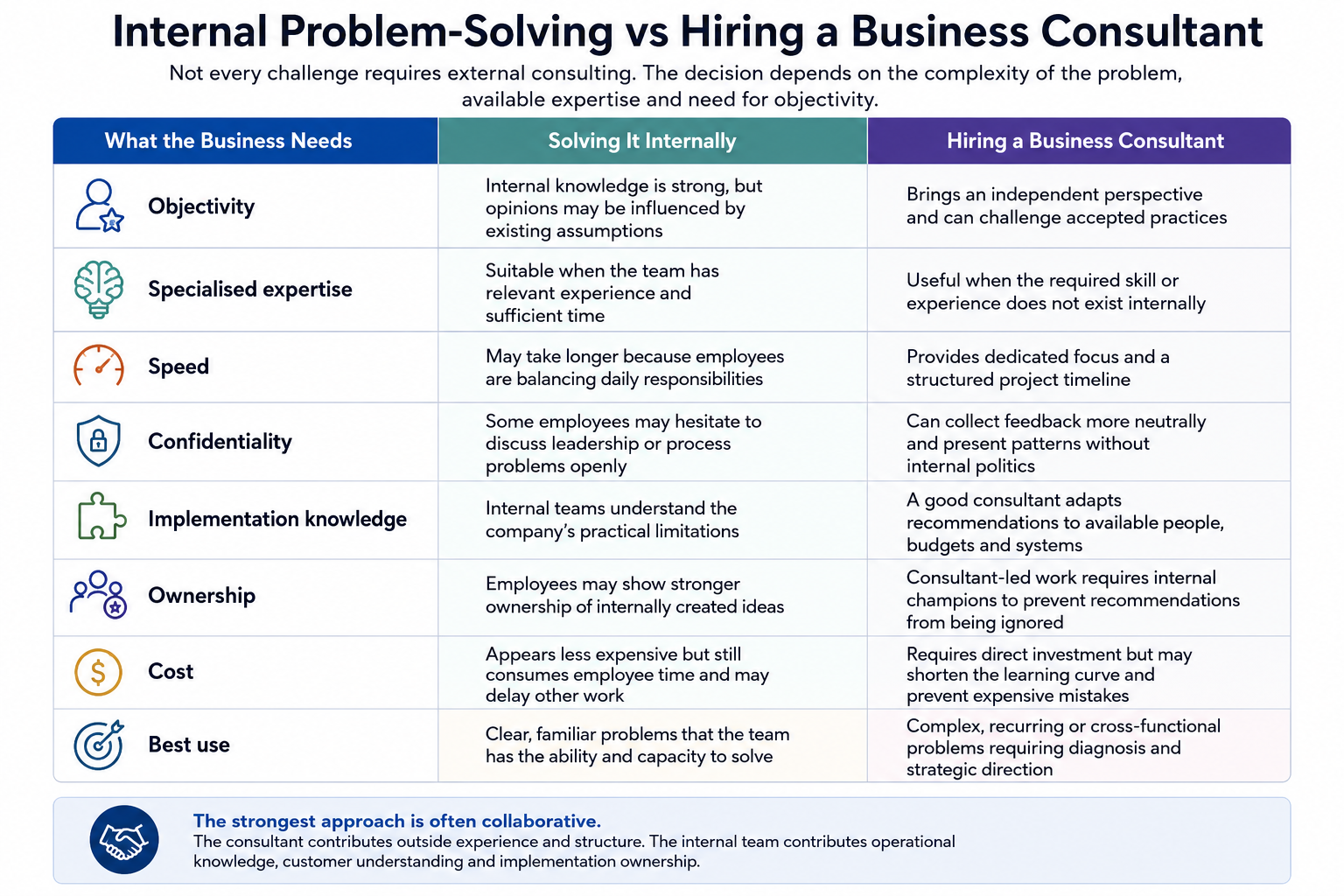
What a Good Business Consultant Should Actually Do
A consultant should not arrive with a generic presentation and apply the same recommendations to every organisation.
A credible consulting process normally includes:
The consultant should learn how the business earns revenue, serves customers, manages its team and competes in the market.
The stated problem may not be the actual problem.
For example, a company asking for more leads may have a weak conversion process. A business asking for employees may first need better systems. A company requesting social media support may need clearer positioning.
Not every weakness deserves immediate attention.
The consultant should help identify which changes will produce the greatest impact and which can wait.
A recommendation has little value when the business lacks the resources to implement it.
The plan should account for the company’s budget, team capacity, technology, timing and leadership readiness.
Some consultants provide analysis only. Others offer implementation support, team training or periodic reviews.
The scope should be clear before the engagement begins.
Consulting should lead to observable improvement. Depending on the project, this may include better lead quality, shorter delivery times, clearer roles, stronger customer retention or improved revenue performance.
How to Choose a Business Consultant in Bangalore
Searching for a business consultant in Bangalore will produce firms and independent consultants with very different specialisations.
Some focus on large-scale management consulting. Others specialise in startups, small businesses, technology, finance, HR, data, marketing or operational transformation. Current Bengaluru listings demonstrate that consulting providers vary significantly in service focus, team size, minimum project cost and industry experience.
Before hiring, ask the following questions:
- What types of business problems do you specialise in?
- Have you worked with organisations at our stage of growth?
- How will you diagnose the problem before recommending a solution?
- What will you require from our team?
- What deliverables will we receive?
- Will you support implementation or provide recommendations only?
- How will progress be measured?
- What happens if the initial diagnosis changes?
- Who will actually work on the engagement?
- Can you explain your recommendations in practical language?
Do not choose purely on the basis of presentation quality, company size or the number of services listed.
The right consultant should understand the problem, communicate clearly and recommend actions that fit your business—not an idealised organisation with unlimited resources.
Common Objections to Hiring a Business Consultant
No consultant will understand the company fully on the first day.
A good consultant does not pretend otherwise. They ask questions, review information, speak with relevant people and test their understanding before offering major recommendations.
Industry experience helps, but curiosity and diagnostic ability are equally important.
You may be correct.
However, knowing the problem and correcting it are different tasks. A consultant can help validate the diagnosis, identify why previous attempts failed and create accountability around implementation.
Poor decisions also carry a cost.
Delayed hiring, ineffective advertising, repeated errors, unnecessary software and unresolved operational problems may cost more than a focused consulting engagement.
The question should be whether the likely business value justifies the investment.
Employees may worry that a consultant has been hired to criticise them or eliminate jobs.
Leadership should explain the consultant’s purpose clearly. In most cases, the objective is to improve systems, clarify priorities and help employees work more effectively—not assign blame.
This is a reasonable concern.
Some consulting assignments fail because the recommendations are too theoretical. Before hiring, clarify whether you need diagnosis, strategy, implementation, training or a combination of these services.
Frequently Asked Questions
What does a business consultant do?
A business consultant analyses an organisation’s challenges, opportunities, systems and strategy. They recommend improvements and may support implementation, training or ongoing performance reviews.
When should a small business hire a consultant?
A small business may benefit when growth has stalled, marketing is ineffective, the founder is overloaded, systems are unclear or the company is preparing to scale.
How long does a consulting engagement take?
The duration depends on the problem. A diagnostic consultation may take a few hours or days, while strategy, restructuring or implementation projects may continue for several months.
Is a business consultant only for struggling companies?
No. Healthy companies hire consultants when entering new markets, launching services, improving processes, introducing technology or preparing for faster growth.
What should I prepare before meeting a consultant?
Prepare a short explanation of the problem, relevant performance information, previous attempts to solve it, current constraints and the outcome you want to achieve.
Can a consultant help with marketing?
Yes, when their expertise includes marketing strategy, positioning, customer acquisition, content, lead generation or sales alignment. The exact scope should be confirmed before engagement.
Should I choose a local consultant?
A local consultant may provide useful knowledge of the Bengaluru market and may be available for in-person workshops. However, expertise, fit and implementation ability are more important than proximity alone.
How can I measure the value of consulting?
Agree on measurable outcomes at the beginning. These may include revenue growth, better lead quality, reduced costs, faster delivery, clearer responsibilities or improved customer retention.
Will a consultant replace my internal team?
A consultant usually complements the internal team. Their role is to provide specialised expertise, objectivity and structure while employees retain the operational knowledge required for implementation.
What is the difference between consulting and coaching?
Consulting generally focuses on diagnosing business problems and recommending solutions. Coaching focuses more on helping the individual think, decide and develop their own capabilities. Some engagements combine both approaches.
Conclusion: External Guidance Can Prevent Internal Problems from Becoming Growth Barriers
Hiring a consultant is not an admission that the business has failed. It is a decision to examine the organisation before recurring problems become more expensive and harder to correct.
The strongest consultants do not create dependency. They help leadership understand the business more clearly, make better decisions and build systems the internal team can continue using.
When searching for a business consultant in Bangalore, look beyond broad promises of growth. Choose a consultant who begins with diagnosis, understands your commercial reality and can translate strategy into practical action.
To explore how external guidance can support your next stage of growth, learn more about our Business Consulting, Marketing Strategy, Marketing and Business Development, Digital Marketing and Corporate Training services, or contact the Litos team to discuss your current challenges and the right consulting approach for your organisation.